 Magyar
HUN-REN Wigner Research Centre for Physics


Keszthelyi Tamás
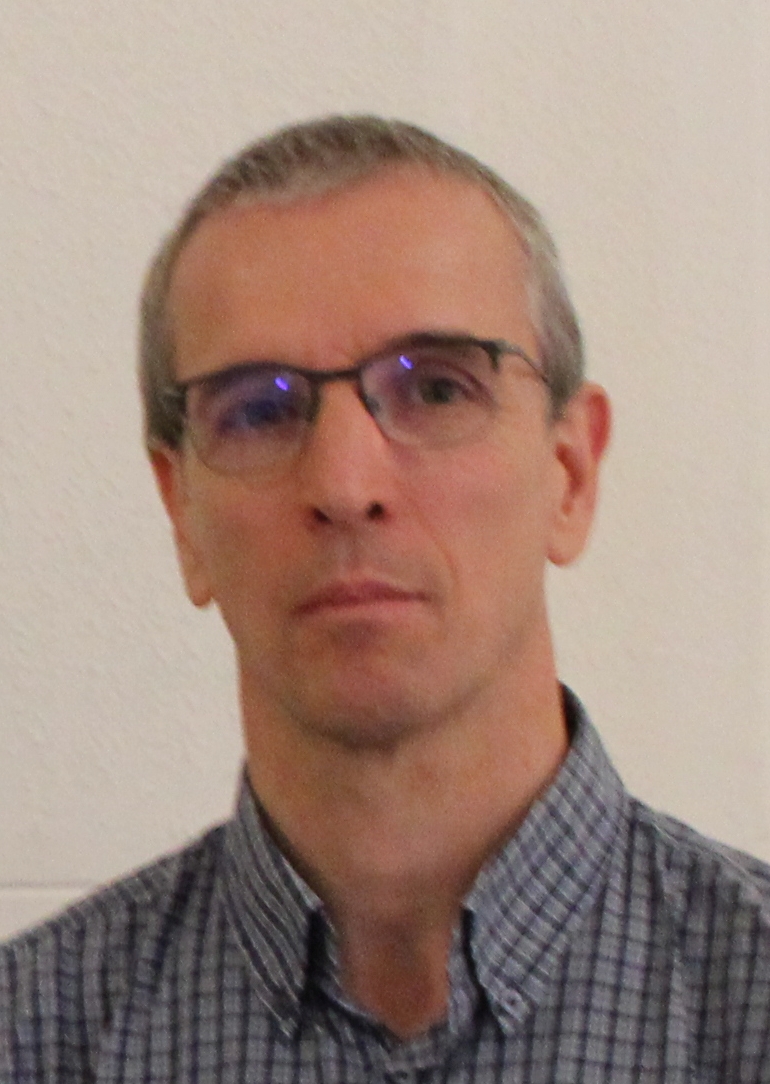
- E-mail: keszthelyi.tamas@wigner.hu
- Phone: +36 1 392 2222 ext. 1986
- Fax: +36 1 395 9151
Tamás Keszthelyi holds an M.Sc. degree in chemical engineering (Technical University, Budapest, Hungary) and an M.Phil. degree in chemistry (University of Southampton, United Kingdom). He received his Ph.D. from he University of Copenhagen, Denmark in 1996, for work carried out at Risø National
Laboratory. Following a postdoctoral appointment at Risø National Laboratory and a three-year stay at Aarhus University (Denmark) as assistant research professor, in 2001 he took up a permanent position at the Chemical Research Centre in Budapest, Hungary. In July 2017 he joined the staff of Wigner RCP as senior research scientist.
He is an experimentalist and worked with several conventional and laser-based, linear and non-linear spectroscopic methods, stationary as well as time-resolved. He has experience in the operation of pulsed ns, ps and fs lasers, with non-linear optics, spectroscopic, cryogenic and ultra-high vacuum equipment. Additionally he also gained substantial expertise with the theoretical methods of high-level quantum chemistry.
CV
DEGREES AND POSITIONS
2017- Senior Research Scientist, Wigner Research Centre for Physics, Budapest, Hungary
2012-2017 Senior Research Scientist, Research Centre for Natural Sciences, Budapest, Hungary
2002-2011 Senior Research Scientist, Chemical Research Centre, Budapest, Hungary
2001-2002 Research Scientist, Chemical Research Centre, Budapest, Hungary
1998-2001 Assistant research professor, Aarhus University, Arhus, Denmark
1996-1998 Postdoctoral fellow, Riso National Laboratory, Roskilde, Denmark
1996 Ph.D. (Chemistry), University of Copenhagen, Denmark
1992 M.Phil. (Chemistry), University of Southampton, United Kingdom
1992 M.Sc. (Chemical Engineering), Technical University, Budapest, Hungary
1990 B.Sc. (Chemical Engineering), Technical University, Budapest, Hungary
AWARDS
2006-2009 Bolyai János Research Fellowship
2002-2005 Bolyai János Research Fellowship
Research
Topics
Time-resolved spectroscopy of transition metal complexes
Methods
Ultrafast transient absorption spectroscopy
 Materials Science by Nuclear Methods