

Hungarian Engineering Supports the JUICE Mission to Jupiter
The European Space Agency’s JUICE spacecraft, currently en route to Jupiter and its icy moons, is still in the early stages of its journey, and Hungarian-developed technology is among the many contributors supporting the mission. The power supply system of PEP experiment designed by engineers at the HUN-REN Wigner Research Centre for Physics has been operating flawlessly since launch in 2023. The mission has already achieved several important milestones, including a series of unique gravity-assist manoeuvres and observations of the rare interstellar comet 3I/ATLAS, as it continues its journey toward one of the most ambitious planetary exploration missions ever undertaken.
The JUICE (Jupiter Icy Moons Explorer) spacecraft was launched on 14 April 2023 and is expected to reach Jupiter, the largest planet in our Solar System, in 2031. One of its eleven scientific instruments is the Particle Environment Package (PEP), a suite designed to investigate the particle environment around Jupiter and its moons. Hungarian researchers and engineers contributed to the development of this instrument package.
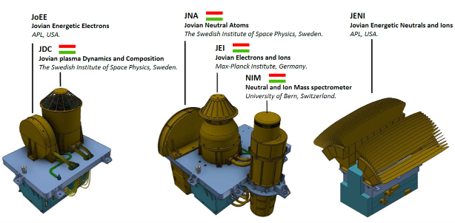
Figure 1. The six detectors comprising the PEP instrument package; the HUN-REN Wigner Research Centre for Physics contribution is marked with a Hungarian flag. (Credit: IRF)
For four of the six detectors that make up the PEP instrument suite, the power supply system, known as the Direct Current Converter (DCC), was developed by specialists at the HUN-REN Wigner Research Centre for Physics (Figure 1). The operation of the system is currently monitored by researchers at the HUN-REN Centre for Energy Research. Since launch, the DCC has performed flawlessly: its power output meets all requirements, while its thermal behaviour under the extreme conditions of space is fully consistent with pre-launch simulations and testing. Hungarian researchers are also involved in the analysis of the first measurements returned by the sensors.
The journey to Jupiter is particularly complex. Rather than travelling along a direct trajectory, JUICE relies on a series of gravity-assist manoeuvres to gain energy and adjust its orbit. A major milestone was reached in August 2024, when, for the first time in the history of space exploration, a trajectory correction was carried out using the combined gravitational influence of the Moon and Earth. During the Lunar–Earth Gravity Assist (LEGA) manoeuvre, the spacecraft flew past the Moon on 19 August 2024 and the Earth one day later. This intricate manoeuvre not only shortened the travel time to Jupiter but also provided an opportunity to verify and calibrate the spacecraft’s scientific instruments. Two further Earth gravity assists are planned during the mission.
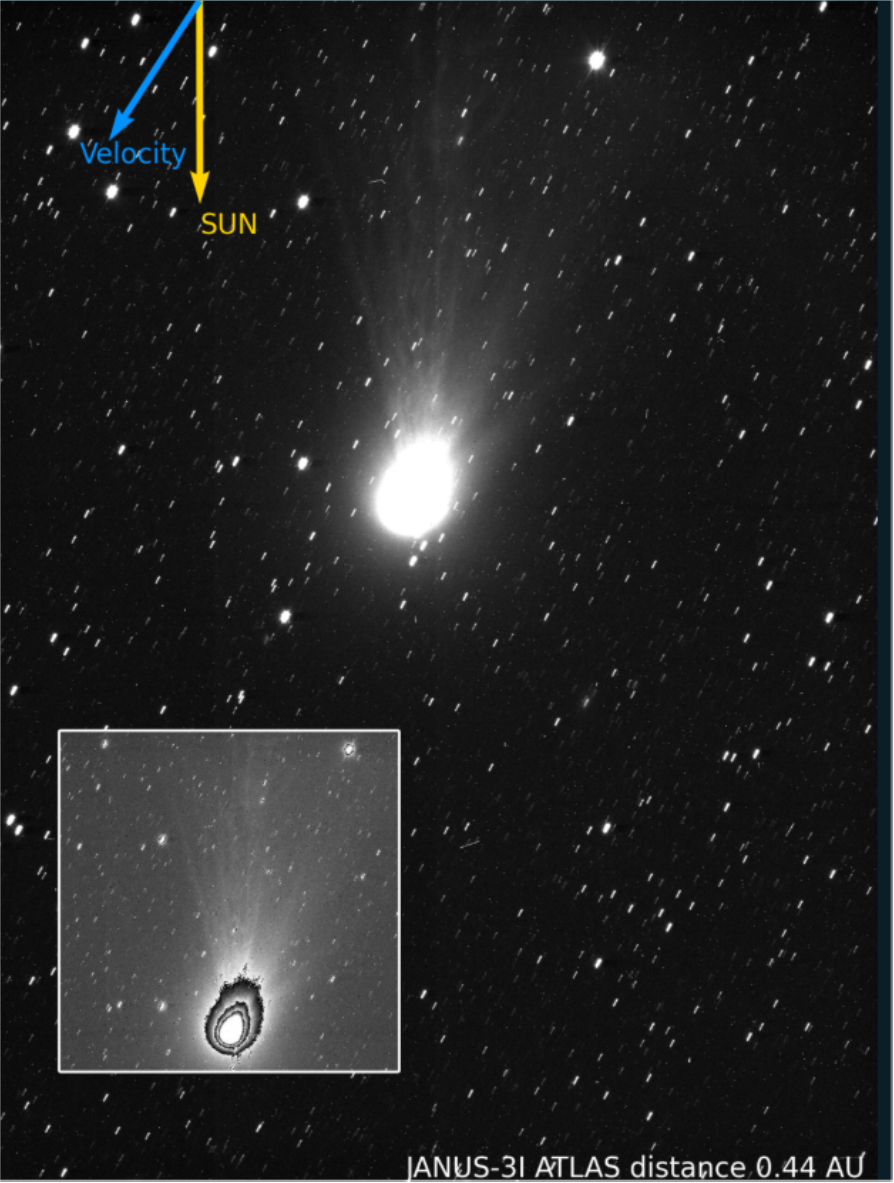
Figure 2. Image of comet 3I/ATLAS captured by the JANUS camera on 6 November 2025. (Credit: ESA/Juice/JANUS)
The long journey has also offered valuable scientific opportunities. In November 2025, JUICE passed close to the interstellar comet 3I/ATLAS. Taking advantage of this rare event, mission scientists activated five scientific instruments, including the PEP suite. The JANUS camera acquired more than 120 images of the object, which originated outside the Solar System (Figure 2), including observations obtained shortly after its closest approach to the Sun. Analysis of the measurements collected by the activated sensors is currently under way, including comparisons with the properties of comets originating within our own Solar System.
The primary scientific objective of JUICE, however, is the detailed exploration of Jupiter and its environment. Jupiter possesses more moons than any other planet in the Solar System and has been a focus of astronomical research for centuries. The mission will pay particular attention to the three large Galilean moons Europa, Ganymede and Callisto, first discovered by Galileo Galilei. Current evidence suggests that vast liquid-water oceans may exist beneath their thick icy crusts, making them prime targets for investigating the emergence of potentially habitable worlds around a giant planet.
The PEP instrument suite will play a central role in these investigations. It will study the tenuous atmospheres, or exospheres, of the moons and provide information on their composition (Figure 3). The instrument is capable of detecting the presence of water and organic compounds in these exospheres. It will also investigate interactions generated by particles accelerated by Jupiter’s magnetic field and subsequently impacting the moons, as well as the magnetosphere of Ganymede—the only moon in the Solar System known to possess its own intrinsic magnetic field.
As JUICE approaches the Jovian system, its scientific programme will expand to include an additional target. The spacecraft is expected to pass within approximately 700–800 kilometres of Kallichore, a moon discovered in 2003, allowing direct observations to be incorporated into the mission plan.
Over the coming years, JUICE will not only explore the secrets of a distant planetary system but will also help scientists understand how potentially habitable worlds may form within the Solar System. The mission offered Hungarian engineers an opportunity to become involved in an ESA major space programme.
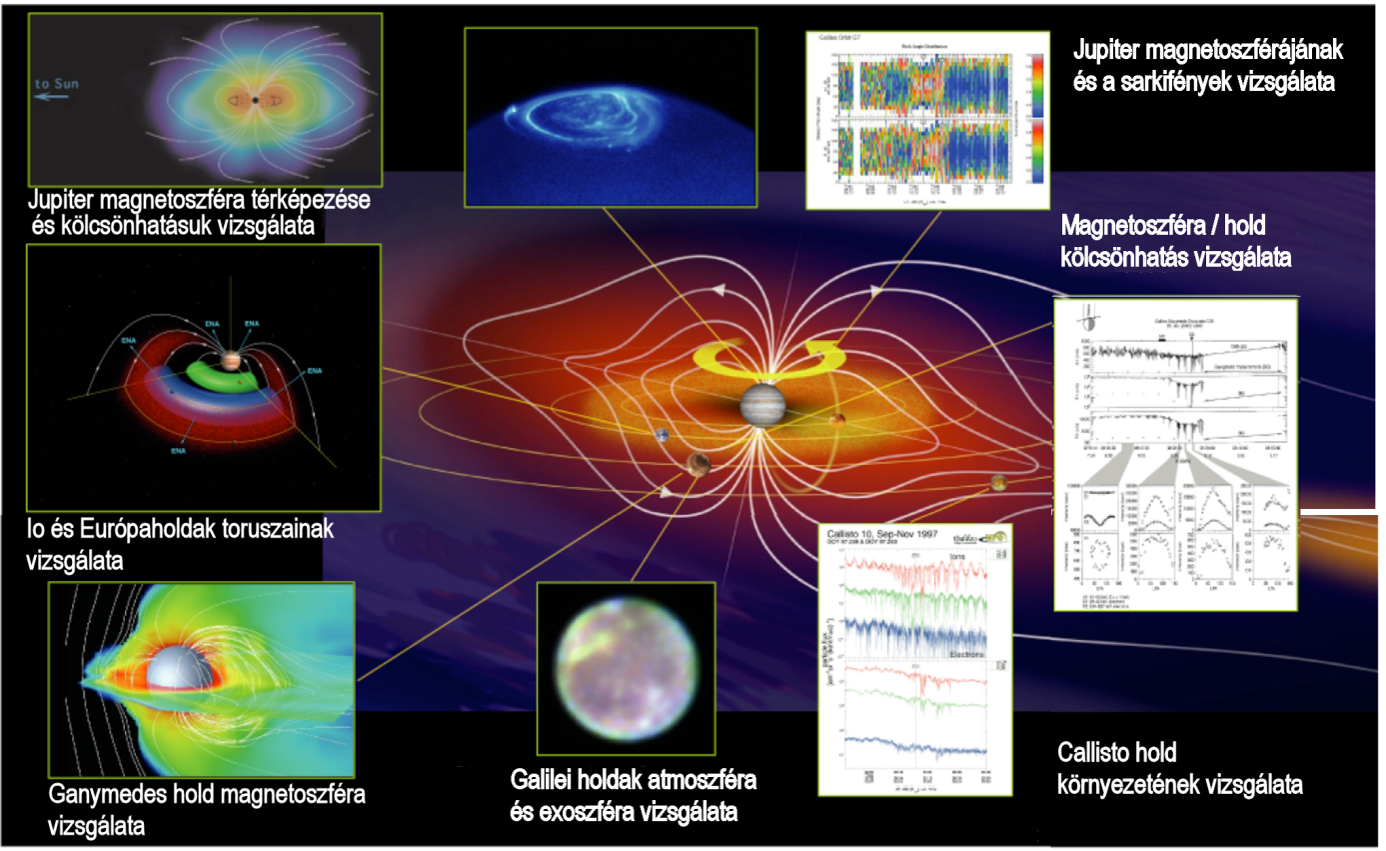
Figure 3: Planned research activities of the PEP experiment at Jupiter (Credit: IRF)
This news article is based on the scientific summary by Sándor Szalai and János Nagy.