

Researchers at the Nanoplasmonic Laser Fusion Research Laboratory (NAPLIFE) have been investigating the feasibility of laser-induced nuclear fusion in nanoscale systems since 2020. The findings of this research, conducted over a five-year period and building on the concept in the patent proposition by Prof Norbert Kroó, Prof László Pál Csernai and Dr István Papp, indicate that under appropriate conditions, fusion reactions may be initiated even at the nanoscale.
The project was led by the HUN-REN Wigner Research Centre for Physics in collaboration with researchers from the Budapest University of Technology and Economics, the University of Szeged, the University of Debrecen, the HUN-REN Centre for Energy Research, and ELI-ALPS in Szeged, as well as international partner universities. The results of the project suggest that nanoplasmonic laser fusion (hereafter referred to as nanofusion) may contribute to improved energy security in the medium to long term.
Fusion-based energy production is theoretically capable of providing high energy density while requiring relatively small amounts of fuel. According to current models, its energy yield may significantly exceed that of fossil-fuel-based or fission-based systems. Potential fuels include light elements such as hydrogen, deuterium and boron. One of the principal advantages of fusion reactions is that, when suitable reaction pathways are selected, they do not produce long-lived radioactive by-products. Consequently, this technology is regarded as one of the most environmentally sustainable energy solutions currently known.
The research conducted within the NAPLIFE project focused on the operating mechanisms of nanoplasmonic laser fusion. The experiments utilised gold nanoparticles resonant to millijoule-energy pulsed lasers, which can enhance the local electromagnetic field and thereby help to create the conditions necessary for fusion reactions. The phenomenon was supported by the detection of reaction products from proton-boron fusion reactions.
The results obtained thus far suggest that the nanoplasmonic approach may represent an alternative direction in fusion energy research over the longer term. At the same time, its application to energy production will require substantial further development. Various approaches to fusion-based energy generation, including large-scale plasma-physics systems, remain at the experimental stage.
The research was carried out with the support of the National Research, Development and Innovation Office within the framework of the National Laboratory Programme (project ID: 2022-2.1.-NL-2022-00002) between 1 October 2022 and 31 March 2026. The demonstration phase of the project has now been completed. From 1 April 2026, further research will continue at the HUN-REN Wigner Research Centre for Physics using internal resources and at a reduced capacity. Future progress will depend on the availability of funding and research resources.
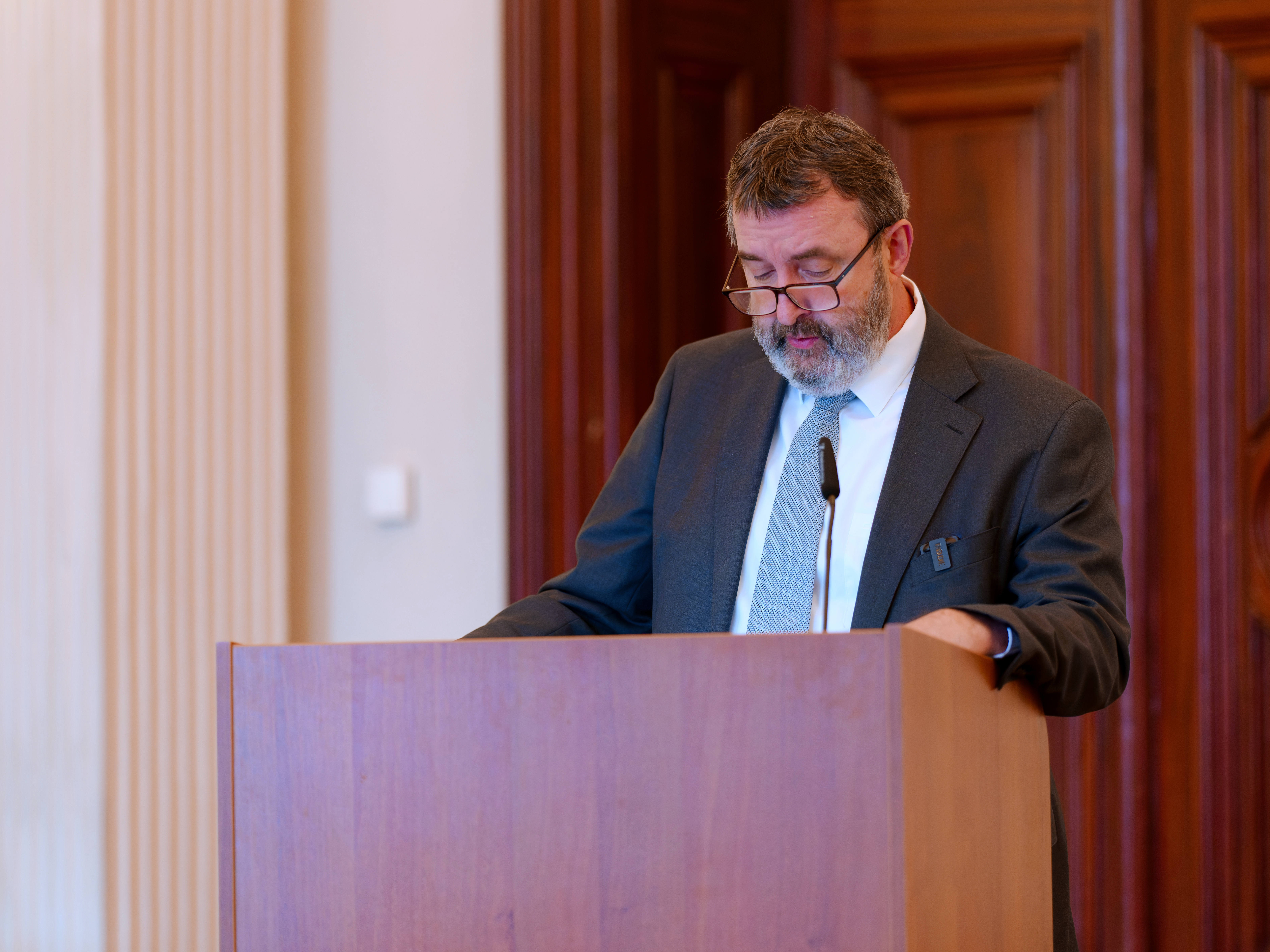
László Palkovics at the project closing event