
 English
 Magyar
Studying Oceanic Lithosphere
The oceanic lithosphere consists of the Earth's crust and the uppermost solid part of the mantle. Its evolution generates raw materials and influences the occurrence of natural hazards and changes in climate. However, its internal structure, particularly the transition between the crust and the mantle (the Mohorovičić discontinuity, or Moho), is still not fully understood. Investigating the Moho is challenging because the oceanic lithosphere is normally covered by several kilometres of seawater and sediments, making it extremely difficult to study. However, tectonic plate movements have pushed fragments of oceanic lithosphere onto the margins of continents. These exposed fragments of oceanic rocks are known as ophiolites. Muography offers a novel, non-invasive method for investigating these structures.
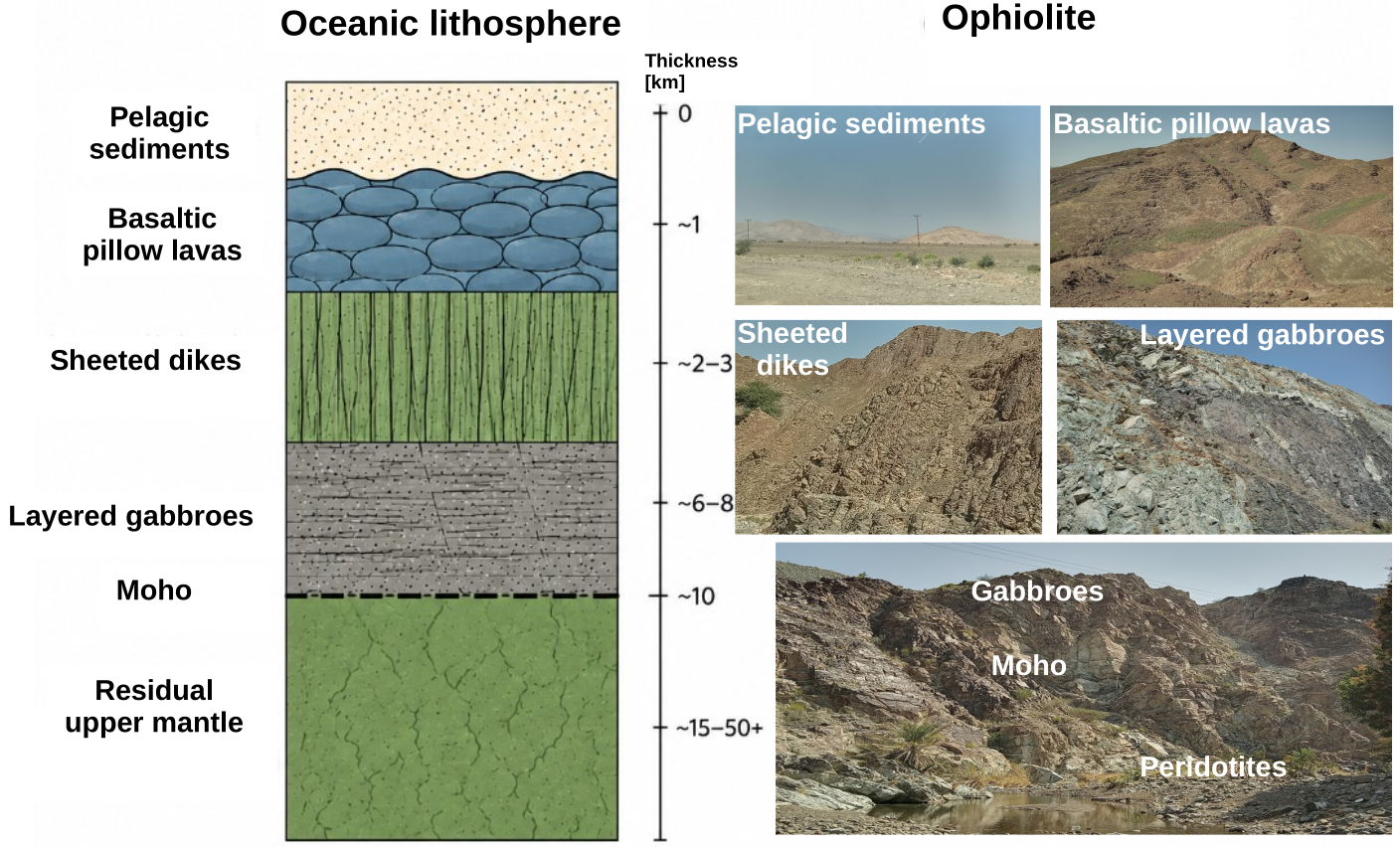 Left: Schematic illustration of the structure of the oceanic lithosphere. Right: Remnants of oceanic lithosphere preserved in the Samail Ophiolite (photographs by László Oláh).
Research focus: Samail Ophiolite, Oman
Our research focuses on the Samail Ophiolite in Oman, one of the world's most extensive and accessible exposures of ancient oceanic lithosphere. Ophiolites are fragments of oceanic crust and upper mantle exposed on land, providing a unique opportunity to study the structure and evolution of the oceanic lithosphere.
In collaboration with Kanazawa University, University of Tokyo and Ministry of Energy and Minerals (MEM) of the Sultanate of Oman, we are applying muography to investigate the large-scale density structure of the Samail Ophiolite, particularly the crust–mantle transition zone. The project combines particle physics, detector development and geological expertise to explore structures that are difficult to investigate using conventional geophysical methods.
From research plans to the first muographic images
The project was initially developed through simulation studies and the design of muographic surveys. In 2024, the research team published its plans for investigating the density structure of the Samail Ophiolite using cosmic-ray muons.
The first muographic observations were subsequently carried out in the Wadi Fizh region of northern Oman. A detector system based on multi-wire proportional chambers was operated to image the internal density structure of the ophiolite. The preliminary results indicated that muography can distinguish between the lower crust, the upper mantle and the intervening Moho Transition Zone.
First cosmic-ray muography of a crust–mantle transition zone
In 2026, our research resulted in the first muographic imaging of a crust–mantle transition zone. The observation system collected data for 171 days from a distance of approximately 400 metres, producing a density image with a spatial resolution of about 3.5 metres.
The measurements revealed distinct density variations within the ophiolite. The results indicate a heterogeneous structure of the Moho Transition Zone, with lower-density material associated with alteration processes and higher-density rocks in the lower part of the investigated section. These findings provide new constraints on the internal structure of the oceanic crust–mantle boundary.
This study demonstrates that muography can bridge the gap between small-scale laboratory measurements and conventional geophysical methods, providing continuous density information at intermediate spatial scales. It establishes a new approach for investigating the structure and evolution of oceanic lithosphere.
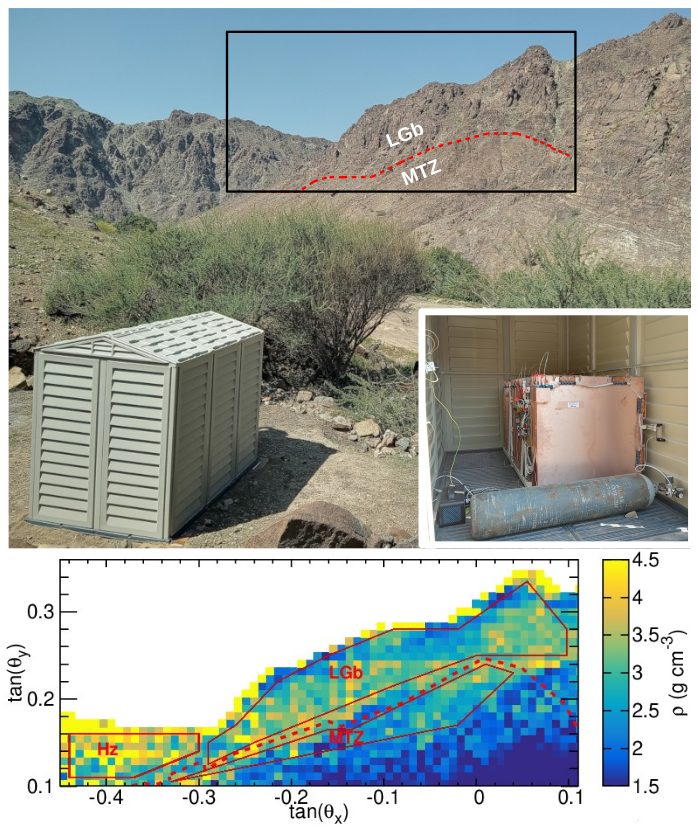 Top: The muographic detector system at the measurement site in Wadi Fizh, Oman. Bottom: The first muographic density image of an oceanic crust–mantle boundary.
Ongoing research and future directions
Our ongoing research aims to extend muographic observations to additional locations within the Samail Ophiolite and to develop higher-resolution three-dimensional density models. By combining muography with geological and geophysical information, we aim to improve our understanding of the Moho Transition Zone and the processes responsible for the formation and evolution of oceanic lithosphere.
Publications
- Oláh, L., et al. (2024). Plans for Muography of Samail Ophiolite. Journal of Advanced Instrumentation in Science, 2024.
- Oláh, L., et al. (2025). First Muography of Samail Ophiolite at Wadi Fizh. Journal of Geography, 134, 615–624.
- Oláh, L., et al. (2026). First cosmic-ray muography of a crust-mantle transition zone. Scientific Reports, 16, 34857.