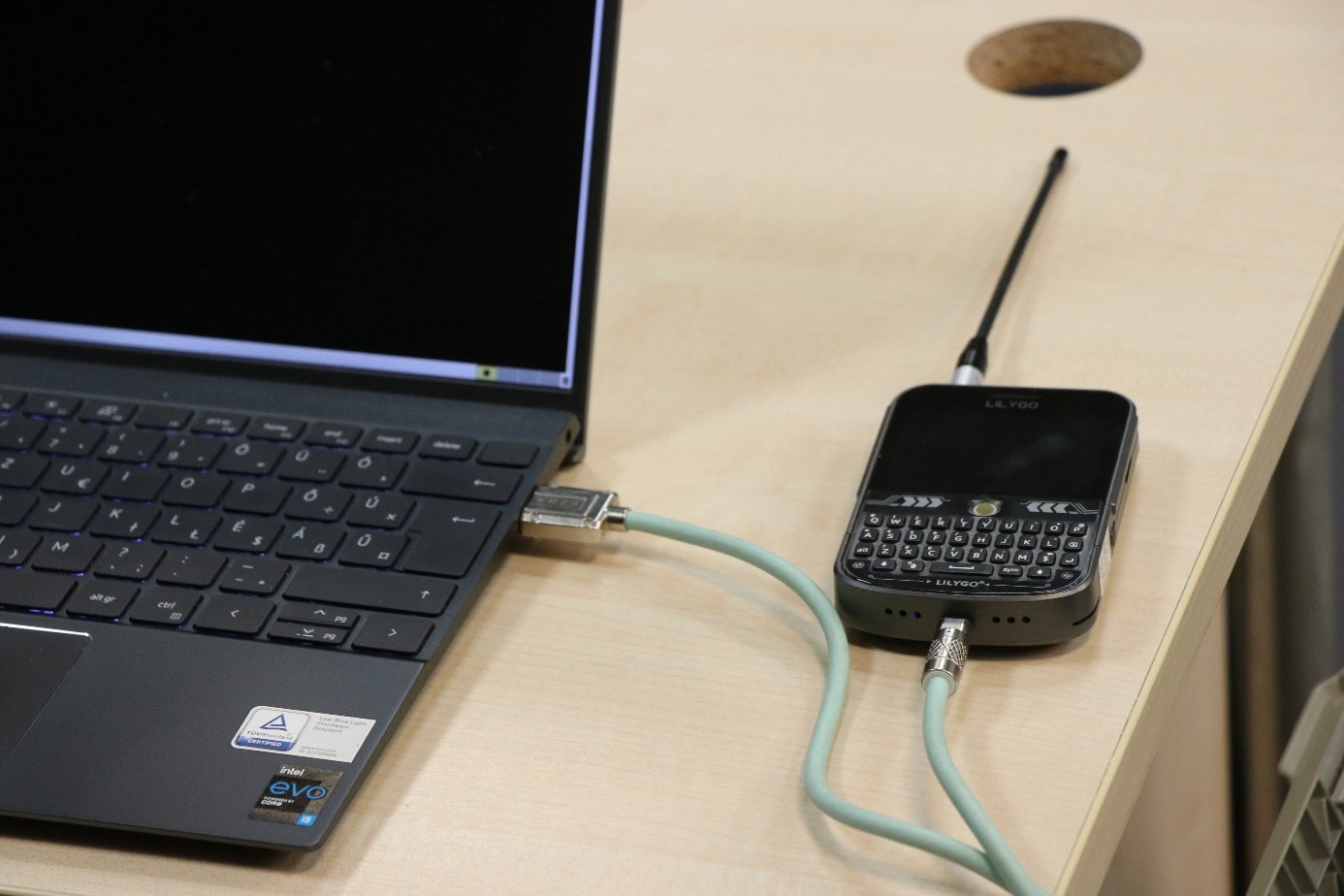

Researchers from the HUN-REN Wigner Research Centre for Physics and the Faculty of Informatics at Eötvös Loránd University (ELTE) have successfully tested the use of quantum key distribution (QKD) on a public radio messaging network as part of the QCIHungary project. During the experiment, carried out on 29 October 2026, they exchanged messages encrypted with a quantum-generated key from opposite sides of Margaret Bridge using the Meshtastic radio network. To the researchers’ knowledge, this was the first time anywhere in the world that an encryption key generated using quantum key distribution had been used to protect Meshtastic messages
Meshtastic and LoRa
Meshtastic is a radio messaging network designed for sending short text messages and is being used increasingly widely around the world. One of its main advantages is that devices communicate directly with one another in a mesh network, eliminating the need for installed communications infrastructure. It is free for anyone to use, and its software is open source. The devices use LoRa digital radio modulation, which can provide a range of several tens of kilometres while operating with very low power consumption and narrow bandwidth. This is broadly comparable to the distance that fibre-optic quantum key distribution systems can span directly.

Quantum key distribution
The best-known application of quantum cryptography is quantum key distribution, in which two remote parties use the laws of quantum physics to establish a shared secret key. Its security is based not on the computational difficulty of mathematical problems, but on physical laws. As a result, even future quantum computers do not pose the same threat to it as they do to conventional public-key cryptographic methods, while any attempt at eavesdropping is, in principle, detectable.
What happened exactly?
In the morning, Mátyás Koniorczyk, Senior Research Fellow at the HUN-REN Wigner Research Centre for Physics, requested a new key from the quantum key distribution device operating at Pro-M Zrt.’s site on Victor Hugo Street and used it to create a secure QCIHungary channel on his radio. He sent the key identifier, but not the key itself, to his colleague Ottó Hanyecz, who was at the HUN-REN Wigner Research Centre for Physics.
Using the identifier, Hanyecz retrieved the same key from the quantum key distribution device operating at Wigner and used it to configure a second radio, as well as a third device that remained at the research centre during the experiment.
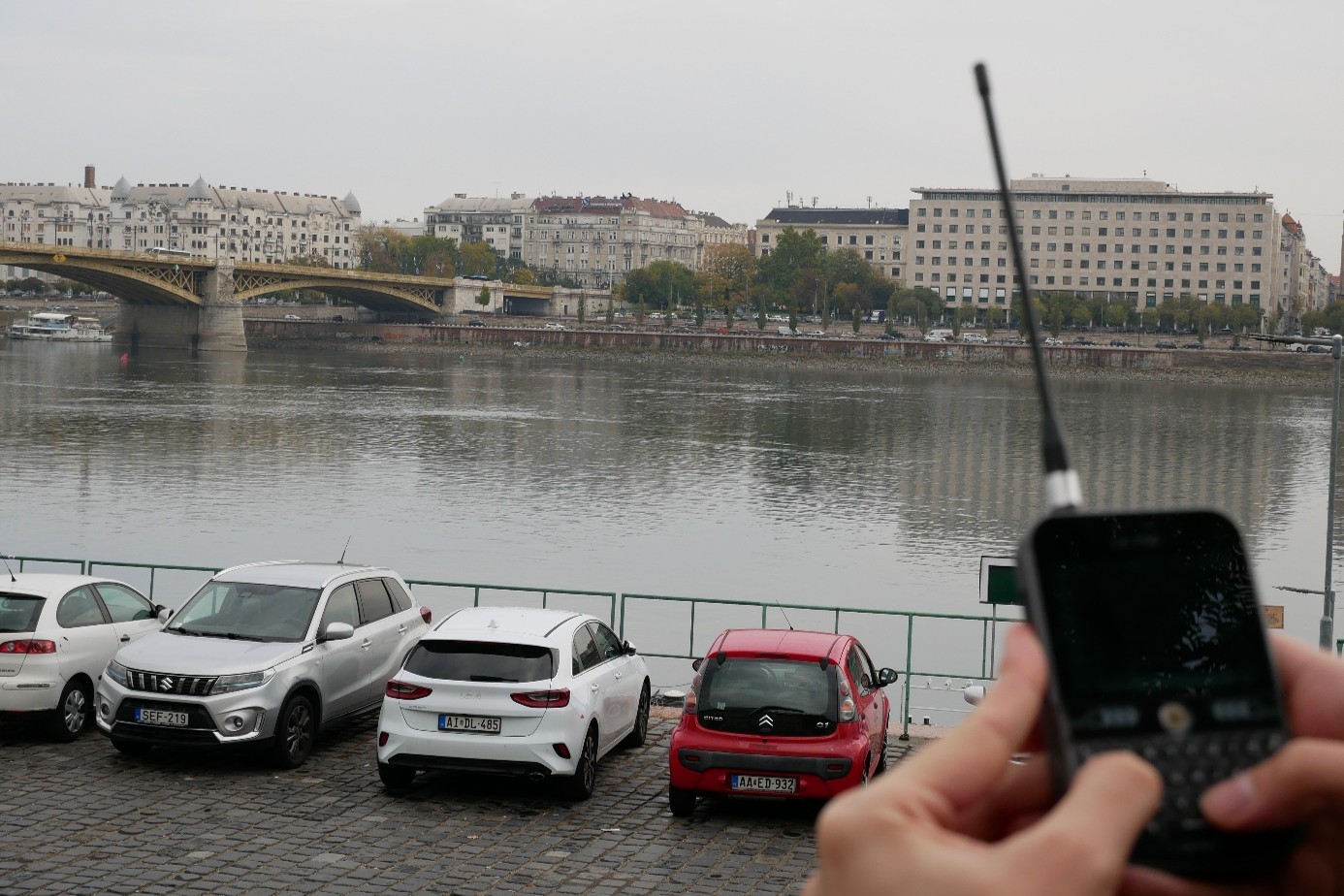
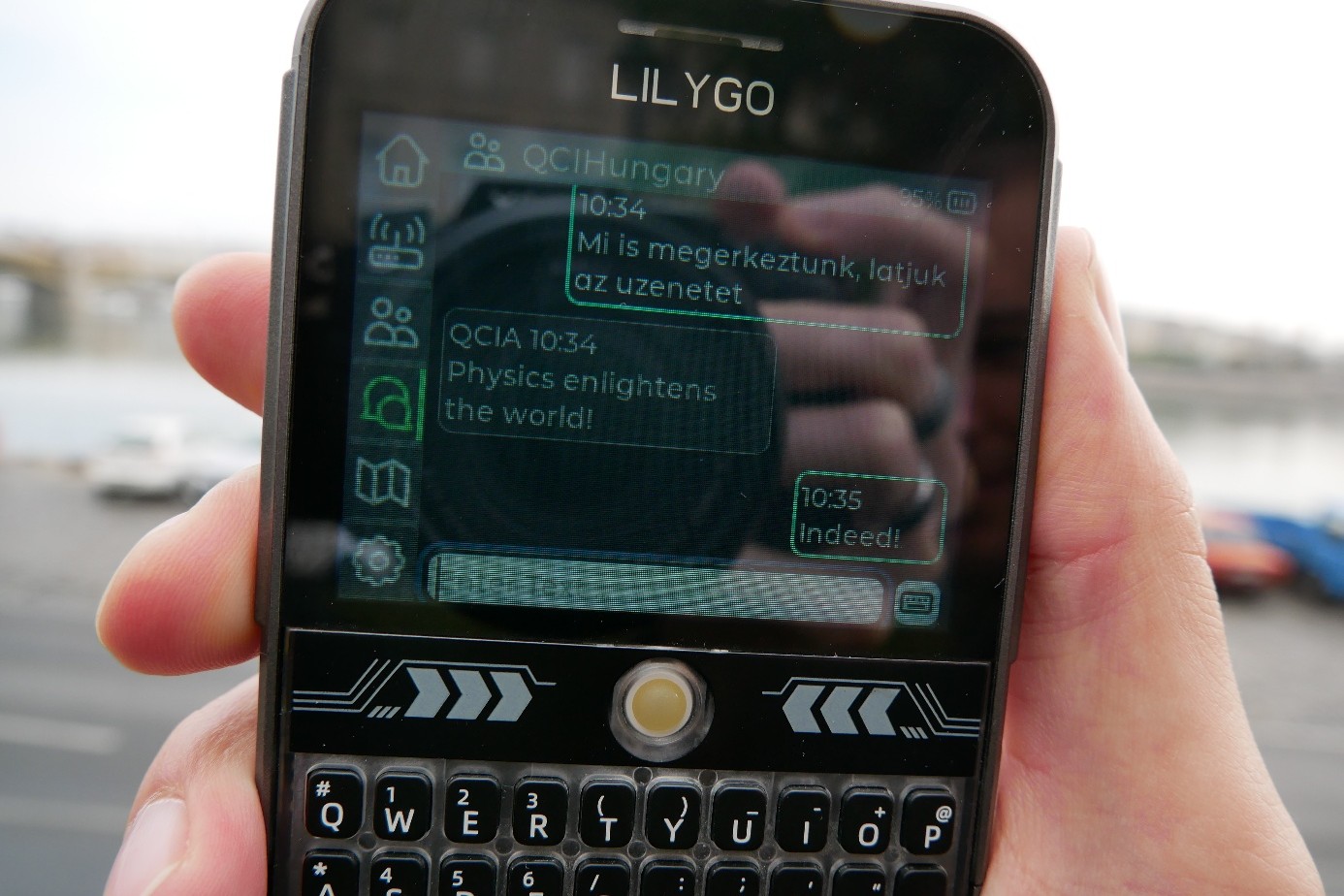
The two researchers then set off towards one another, one from Szent István Boulevard on the Pest side and the other from Széll Kálmán Square in Buda. Between 11:21 and 11:39, they exchanged encrypted messages, initially from a distance of around 1.2 kilometres and eventually from the two ends of Margaret Bridge, across the Danube. One message read, “Physics enlightens the world!”, to which the reply was, “Indeed!”. They also announced the successful exchange on the public Meshtastic channel.
The researchers continued the experiment while on the move. On the bus back to the HUN-REN Wigner Research Centre for Physics, they sent additional test messages. The radio left at the research centre received two of them, the first from a distance of around 4 kilometres.
Two small GPS trackers recorded the messages and signal strength along the route. The data showed that some of the messages had been relayed by devices belonging to other Meshtastic users in Budapest. The network therefore operated in its usual way, while the contents of the quantum-key-protected messages remained unreadable without the correct encryption key.
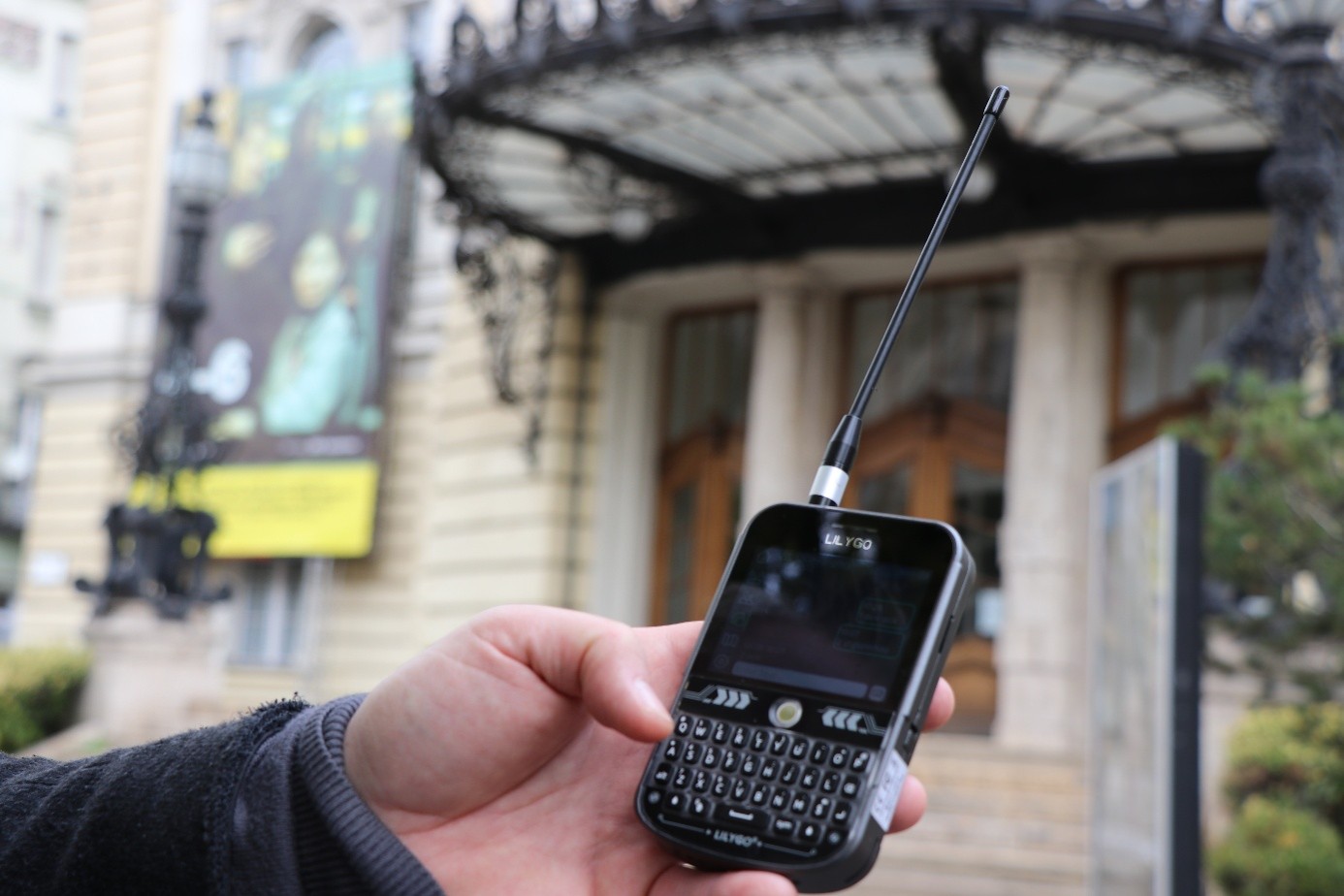
The experiment demonstrated that encryption keys generated within a quantum communications infrastructure can also be used in a simple and widely accessible radio system of this kind. It also provided an example of how emerging quantum communication technologies can be integrated with existing communications systems.
The QCIHungary project
QCIHungary is Hungary’s contribution to the European Union’s EuroQCI (European Quantum Communication Infrastructure) initiative, which aims to build a quantum-secured communications infrastructure spanning the EU.
The Hungarian consortium comprises Pro-M Zrt., Budapest University of Technology and Economics, the Faculty of Informatics at Eötvös Loránd University, and the HUN-REN Wigner Research Centre for Physics.
The project is funded under the Digital Europe Programme and is laying the foundations for a quantum communications backbone linking Budapest with Győr and Szeged.