

A research programme aimed at the comprehensive development of the Quantum Information National Laboratory (QNL), supported by more than HUF 3 billion in funding, has been successfully completed. The collaboration between the HUN-REN Wigner Research Centre for Physics, the Budapest University of Technology and Economics (BME) and Eötvös Loránd University (ELTE) has delivered significant advances in quantum communication, the development of quantum technology devices and quantum computing. Hungary’s first multi-node quantum communication test network has been built, new quantum technology devices and computational methods have been developed, and the international standing of Hungary’s quantum research community has been further strengthened.
The programme’s foundations
Advances in quantum technologies are opening up fundamentally new possibilities for processing, storing and securely transmitting information. Often referred to as the ‘second quantum revolution’, this transformation has the potential to reshape many areas of the economy and society over the long term. It is therefore of strategic importance for Hungary to play an active role in these developments. Established in 2020, the Quantum Information National Laboratory brings together leading Hungarian physicists, engineers, mathematicians and computer scientists with the aim of keeping Hungary at the forefront of international quantum technology research.
The project, entitled ‘Comprehensive Development of the Quantum Information National Laboratory’, was launched on 1 October 2022 with HUF 3.275 billion in funding from the National Research, Development and Innovation Office. Research focused on three strategic areas: building a quantum communication network, the physical implementation of the fundamental building blocks of quantum information science, and advancing quantum computing and the simulation of quantum systems.
A quantum-secure network built in Hungary
One of the project’s most significant achievements was the construction, with the involvement of Magyar Telekom Plc, of Hungary’s first multi-node quantum key distribution (QKD) test network equipped with key management capabilities. This represents an important step towards establishing quantum-secure communication between Hungarian institutions and connecting to future European quantum communication networks. Work is also under way, in collaboration with One Ltd, to establish a free-space quantum communication link.
The researchers also further developed a quantum random number generator and photon-pair sources for quantum key distribution, significantly increasing their technology readiness levels.
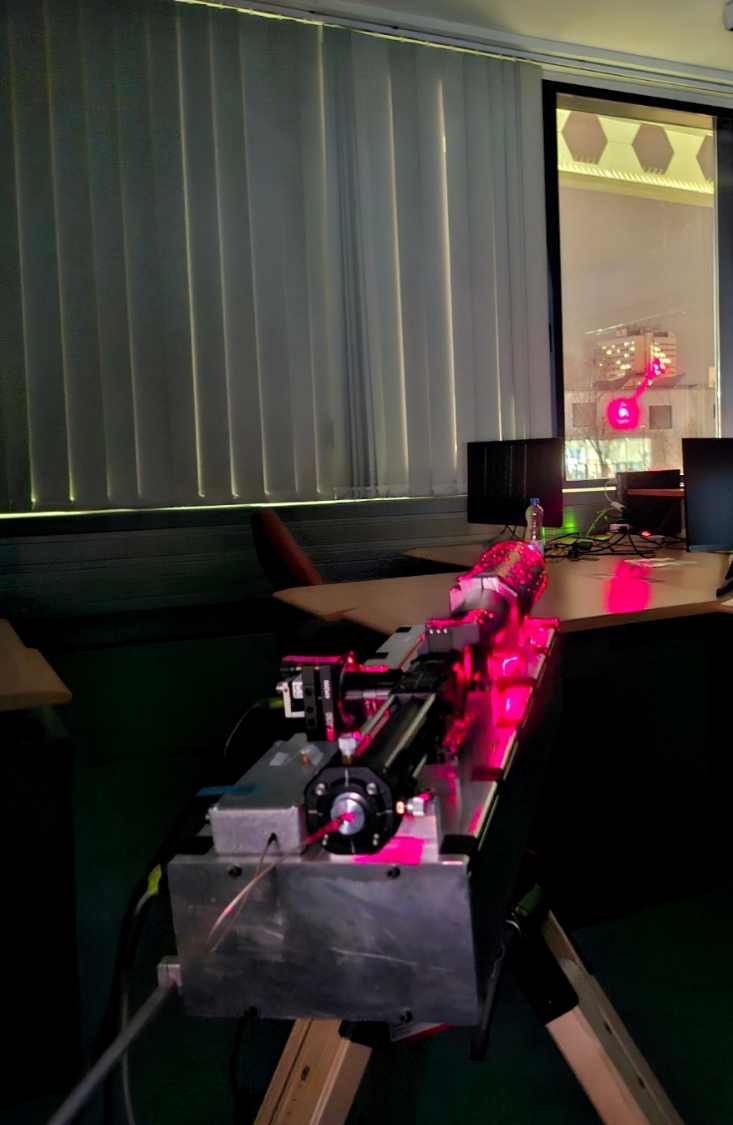
In quantum technology device development, QNL research groups have brought the laboratory capabilities supporting several different technologies up to internationally competitive standards. In superconducting quantum technologies, they have created a novel structure that could, in the longer term, pave the way for the implementation of topological qubits. Advances in atom- and photon-based systems are enabling new quantum technology applications, while research based on specific crystal defects in diamond has led to the development of quantum sensing devices. An important milestone in optical quantum computing was the completion of the first quantum measurements on a QUIX photonic chip.
New algorithms and methods for quantum computing
Hungary has established an internationally competitive pool of expertise in quantum computing, whose members routinely use remotely accessible quantum computers. Researchers have developed new quantum and hybrid algorithms for solving complex optimisation problems and have further advanced the internationally competitive Piquasso photonic quantum computer simulator.
Methods developed in Hungary for assessing the performance of quantum computers have also been incorporated into European assessment procedures. Significant advances have also been made in post-quantum cryptography, which is designed to remain secure even against future quantum computers.
Building the next generation of quantum researchers
Another major achievement of the project has been the strengthening of Hungary’s pipeline of quantum specialists. A total of 94 doctoral, 88 Master’s and 86 Bachelor’s students took part in the work of the QNL. Research conducted within the programme contributed to the completion of 39 doctoral degrees, 68 Master’s degrees and 63 Bachelor’s degrees.
New specialisations in quantum information have been introduced at BME and ELTE, while around 200 students are already enrolled in the Physicist-Engineer BSc programme launched by BME in 2023.
The Quantum Information National Laboratory brings together the expertise of more than 100 researchers holding scientific degrees and has become a major Hungarian contributor to international quantum technology research. During the project, researchers participated in 45 international consortium collaborations, established links with more than 100 research institutions abroad and developed partnerships with a number of leading technology companies.
The research resulted in 421 scientific publications, 314 of which were published in top-quartile (Q1) journals. The wider dissemination of the scientific results was supported by around 700 public engagement talks, articles and interviews, as well as numerous national and international professional and scientific events.
From research results to industrial applications
The completion of the comprehensive development of the Quantum Information National Laboratory has created research infrastructure and a knowledge base that can strengthen Hungary’s competitiveness over the long term. Building on these foundations, new innovation projects have already been launched, while further plans include continued development of the research infrastructure and the creation of new technology spin-off companies.
Hungarian industry has also shown considerable interest in the practical application of the research results, with several companies open to further innovation partnerships. The institutions participating in the QNL are working with industry and government stakeholders to identify opportunities for further development and are also advocating the creation of a national quantum technology strategy.