

2021
Search for new physics at the LHC and detector operation. — Searches are ongoing for the production of supersymmetric particles, in collaboration with ELTE colleagues, in particular for scalar top quarks (stops) using the full Run 2 data set. Our latest involvement was in an update of the analysis method developed in our earlier publication [JHEP 03 (2019) 031)]. It now utilizes the latest deep learning techniques in CMS to identify Higgs bosons, W and Z bosons and boosted hadronically decaying top quarks.
We have taken the last turn before the finish line in the preparation of the CMS Tracker detector for Run 3 of the Large Hadron Collider (LHC). We co-lead the organization to refurbish the pixel detector [1]. The components which were designed and produced by our group did not need any rework, but we have repaired two (DOH) control boards that have been exchanged with spare boards. We have played a major role in the recommissioning of the detector after reinsertion and verifying its performance by reestablishing time alignment with cosmic ray measurements and in LHC beam test collisions.
SuShi septum for the Future Circular Collider (FCC). — In collaboration with CERN, the research group is developing a septum magnet prototype for FCC [2], based on a new concept: the application of a passive superconducting shield (SuShi) inside the bore of a superconducting canted cosine theta magnet, to create a field-free channel for the circulating beam, while the extracted beam would be kicked into the high-field domain by an upstream kicker magnet. All components of the magnet have been manufactured and are ready for winding and assembly (Fig. 1).
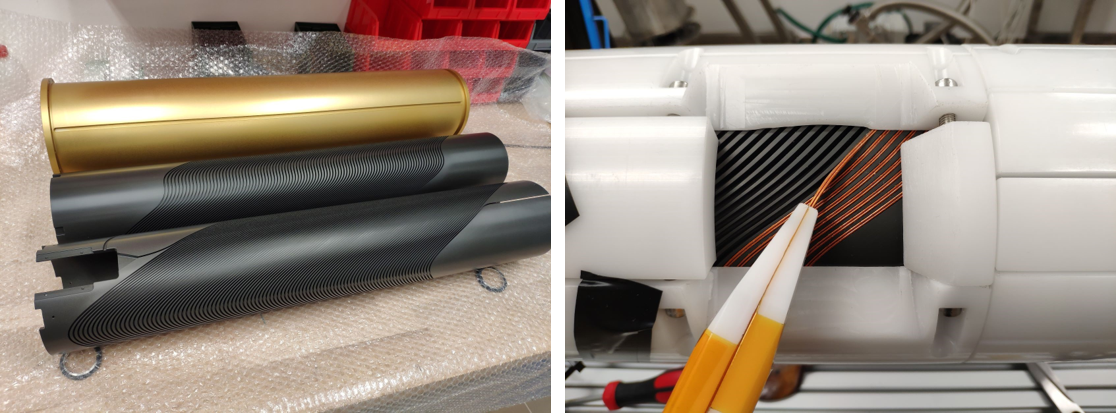
Figure 1. The hard-anodized aluminum formers and the winding test of the SuShi septum magnet prototype.
Hadron therapy. — The HITRIplus (Heavy Ion Therapy Research Integration Plus) H2020 project started in 2021 with the aim of creating a reference design of a small superconducting synchrotron for hadron therapy, among others. Treatment of tumors using charged particle beams (protons, carbon or other ions) has the advantage compared to X-ray therapy of a much greater contrast of energy deposition between the tumor and the surrounding healthy tissues. However, this treatment method is much less widespread due to the complexity, large size and high construction and operational costs of these machines. The application of high-field superconducting accelerator magnets could very significantly decrease both the footprint and the associated costs of these machines. Our research group has actively participated in the design of a novel, strongly curved magnet prototype, and worked out the optimization algorithm of the magnet winding to achieve the ideal magnetic field pattern. Two such winding geometries are shown in Fig. 2.
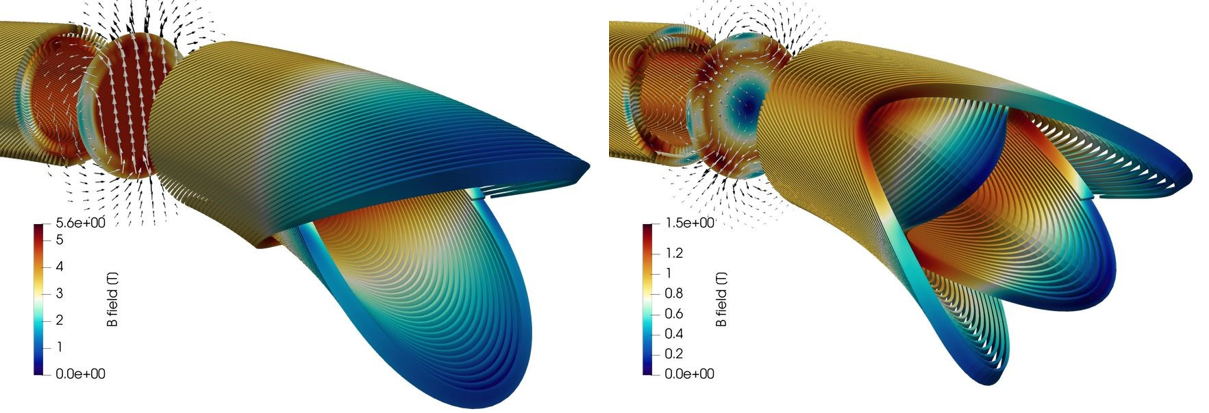
Figure 2. Optimized winding geometries of curved “canted cosine theta” superconducting magnet producing a dipole (bending) and quadrupole (focusing) field.
CMS Tracker Phase 2 upgrade for the High Luminosity LHC. — As preparation for the High Luminosity LHC, the CMS Tracker collaboration is going to replace its entire tracking system during the next long shutdown of the LHC, between 2025 and 2027. The upgraded Outer Tracker will consists of about 13000 silicon detector modules, each of which equipped with up to four different kinds of hybrid electronic components responsible for powering and read-out. In part of the Quality Assurance Plan, the inspection of a third of the hybrids (about 20000 pieces) will be performed at Wigner between 2022 and 2025 as intermediate step of the detector production.
In 2021, several upgrades have been performed to prepare our infrastructure for handling these sensitive components. A humidifier with water-cleaning system and two more air conditioning units have been installed in the clean room and a new system developed for temperature, humidity and air quality monitoring. Our stereo-microscope have been upgraded and two more microscopes installed. The large area optical scanner has also been upgraded with a color camera and with colored LED lighting. Their inclusion to the scanner software is ongoing.
In 2021, during the development and prototyping phase of the hybrids, we have inspected several prototype units in our lab and processed them with the optical scanner. We have helped with the finalization of the inspection checklist and in the development of the production database. The hybrid production project passed the Engineering Design Report at the end of 2021.