

Practical entanglement distillation method that can be useful for quantum communication and distributed quantum computing
In their recent work published in Physical Review Letters, Orsolya Kálmán, Tamás Kiss, Aurél Gábris (HUN-REN Wigner RCP) and Igor Jex (Czech Technical University in Prague) have proposed a new scheme which produces, almost perfectly, one of the maximally entangled Bell-pairs, without needing any a priori information about the input state, other than the fact that the initial states are not too noisy. The new, universal procedure works with eight input pairs to produce, in a probabilistic manner, the almost perfect, prescribed Bell state, which contains quadratically reduced incoherent noise.
Quantum entanglement is at the heart of quantum information processing: It is one of the main resources needed for quantum computation or communication. When creating and sharing entangled qubits between two distant parties, noise inevitably hampers the process, resulting in a degraded quantum state. In entanglement distillation schemes, more qubit pairs are processed via local operations and classical communication, resulting in fewer pairs, but with higher entanglement. Well-known distillation schemes usually exploit some knowledge about the input quantum state. The new procedure involves three iterations, repeating the same core step. Two iterations of the core step (requiring four input pairs) are sufficient to produce the almost perfect Bell-pair if one knows that the input pair is one of the Bell states slightly distorted by some noise. The unique combination of universality, practicality, and scalability makes this approach well-suited for future quantum communication, distributed quantum computing, or multi-core quantum networks, where many devices must reliably share high-quality entanglement.
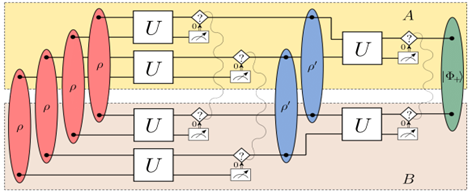
Fig.: Schematic representation of two iterations of the core step of the protocol, which can transform four slightly noisy Bell states into an almost perfect Bell pair.