

Cosmic-Ray Imaging Reveals Hidden Structure of the Oceanic Crust–Mantle Boundary in Oman
An international research team has produced the first muographic image of the crust–mantle transition zone in the Samail Ophiolite, opening a new window into the structure of Earth's oceanic lithosphere.
Researchers from HUN-REN Wigner Research Centre for Physics (Hungary), Kanazawa University (Japan), The University of Tokyo (Japan), AIST (Japan), JAMSTEC (Japan) and the Ministry of Energy and Minerals of Oman have successfully used cosmic-ray muography to visualize the internal density structure of one of the largest and best-preserved sections of ancient oceanic lithosphere. Their findings have been published in Scientific Reports.
Understanding the boundary between Earth's crust and mantle is fundamental to Earth science. This interface, known as the Mohorovičić discontinuity (commonly known as the Moho), lies approximately 5–7 km beneath the ocean floor and about 20–40 km beneath the continents. It plays a key role in the exchange of heat, magma, and fluids within the Earth. These processes influence the formation and evolution of oceanic crust, plate tectonics, volcanic activity, geothermal systems, and the concentration of many mineral resources. 'However, the internal structure of the crust–mantle transition has remained difficult to observe directly because existing approaches either rely on small rock samples analyzed in laboratories or provide averaged information over much larger geological volumes', said Kanazawa University professor Susumu Umino.
The international team addressed this challenge using cosmic-ray muography, an imaging technique based on naturally occurring high-energy muons produced in Earth's atmosphere. Similar to how X-rays reveal the internal structure of the human body, muography allows researchers to investigate the interior of large geological formations by measuring the number of muons that pass through different parts of the rock.
The researchers deployed a high-resolution muography detector at Wadi Fizh in northern Oman, within the world-famous Samail Ophiolite—the largest and best-preserved fragment of ancient oceanic crust and upper mantle exposed on land. The detector collected cosmic-ray muon data continuously for 171 days from a distance of approximately 400 meters, producing a density image with a spatial resolution of approximately 3.5 meters.
'The measurements revealed that the Moho Transition Zone (MTZ) at Wadi Fizh is much more complex than a simple gradual boundary between crust and mantle. The layered gabbros (LGb) forming the lower oceanic crust show an average density of 3.03 g/cm³, while lower-density regions (2.72 g/cm³) within the transition zone indicate enhanced alteration of the rocks. Beneath these regions, higher densities (3.38 g/cm³) are consistent with mantle-derived peridotites (Hz) covered by only a thin gabbroic layer', said HUN-REN Wigner RCP researcher László Oláh.
These results demonstrate that the crust–mantle transition at Wadi Fizh is spatially heterogeneous, revealing variations that cannot be captured by traditional observations alone. The study provides new insights into the internal structure of the oceanic lithosphere and improves our understanding of the geological processes that shape Earth's crust–mantle boundary.
Beyond this specific geological discovery, the research demonstrates the potential of muography as a powerful geophysical imaging method. By bridging the scale gap between laboratory measurements and conventional geophysical surveys, muography enables continuous, in situ mapping of density variations over tens to hundreds of meters. This capability can complement existing techniques in studies of geological structures, volcanic systems, geothermal resources, mineral exploration, and subsurface processes.
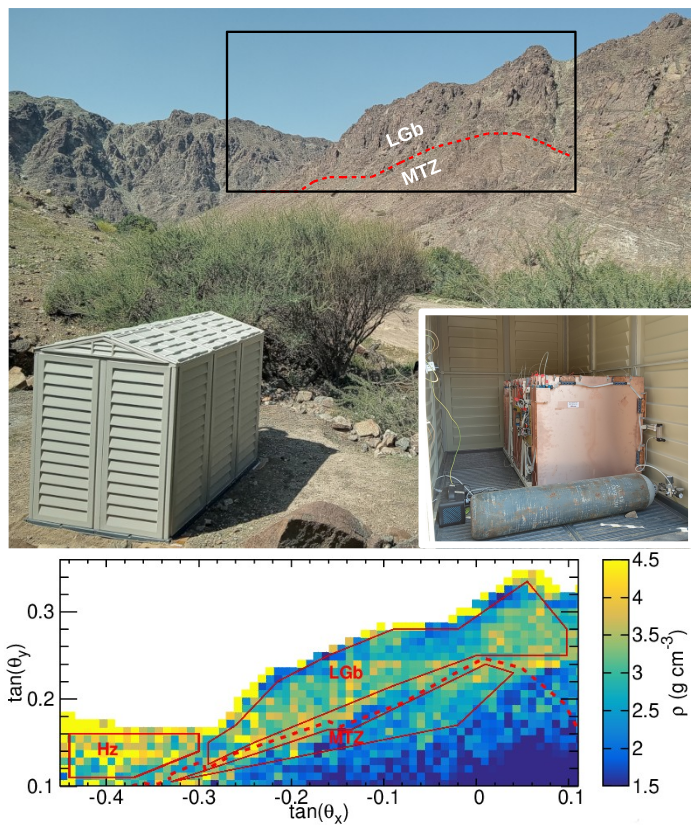
Upper: Photographs of the muography experimental setup at Wadi Fizh, Oman.
Lower: The first muographic density image of an oceanic crust–mantle boundary.