
2023
Integrable quantum field theories and their applications. — The aim of our group is to develop new integrable techniques and apply them in simplified models relevant for particle and statistical physics. During 2023 one postdoctoral researcher (Georgios Linardopoulos) left, while two postdoctoral researchers (Ramon Miravitllas Mas and Dennis le Plat) and a PhD student (Bercel Boldis) joined the group. We published 9 papers in high-prestige journals (PLB, PRD, JHEP, JPA) and finished 4 preprints. We disseminated the results on more than 6 highly renowned conferences and workshops and gave several public talks, see https://wigner.hu/~bajnok/Hologroup/. The results, we achieved in the year 2023, can be grouped into three research topics:
I. Correlation functions of the maximally supersymmetric four-dimensional gauge theory
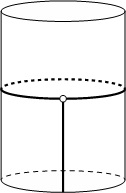
In our previous works we have already shown that the 3-point functions of the maximally supersymmetric four-dimensional gauge theory can be described as finite volume form factors. We thus put a lot of effort in calculating the finite volume form factors of integrable two-dimensional quantum field theories. In doing so we managed to develop a new technique, which is based on the large separation limit of bilocal operators' expectation values. For this we determined the excited state expectation value of a bilocal operator and formulated a systematic way how to extract the finite volume form factors when the operators are taken far apart. We elaborated the programme explicitly up to the third Lüscher order and provided the all-order parametrization of the finite volume form factors in terms of connected non-diagonal infinite volume form factors and volume dependent measure factors, based on the Thermodynamic Bethe Ansatz (TBA) pseudo energies.
We also initiated a new approach to investigate 3-point functions in generic conformal field theories based on their integrable description. As a first step we expanded the TBA equation of the Lee-Yang model at small volume and extracted the integrable description of diagonal 3-point functions. We then extended the results for the sine-Gordon model and its minimal model reductions. We presented these results at the yearly IGST conference in Zürich. Unfortunately, for generic operators our leading order expansion vanishes, and we had to develop a second order calculation, which is under testing now.
Eventually, the gauge theory's 3-point functions should be expressed in terms of the Q-functions of the quantum spectral curve formulation. We also advanced into this direction. We developed a mathematica package which calculates numerically the spectrum of anomalous dimensions in the maximally supersymmetric gauge theory. We elaborated the method for the low-lying spectrum (first 160 states at weak coupling). By using the numerical bootstrap for the 4-point function, these 160 states enabled us to extract certain 3-point functions with very high precision numerically.
II. Integrability with boundaries and defects and their applications
In this year we focused on extending and checking our previous results, which we obtained in gauge theories with psu(2|2) symmetry for integrable boundaries. We managed to dualize our results, which describe the overlaps of the recently discovered 't Hooft loop. We also managed to check some of our results at strong coupling using a newly developed perturbation theory valid for semi-classical states. We also used boundary integrability to calculate anomaly coefficients in the 2-point function in the presence of domain walls in the gauge theory. Recently specific boundaries, called cross-caps, got considerable interest. We contributed into this new research directions by classifying integrable cross-cap states in string theory at the classical level.
In order to connect the integrable descriptions in statistical field theories to real experiments we need to formulate the right mapping between them. In an invited review article, we summarized the relation between the form factor approach to two-point functions and their relations to response functions available in neutron scattering experiments [1].
III. Non-perturbative phenomena emerging from the perturbative series
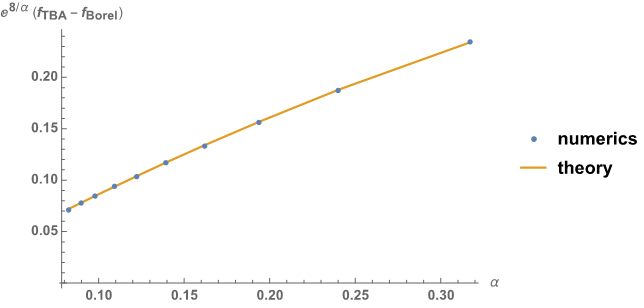
We had a breakthrough result in this part of our project. We managed to describe the full trans-series analytically for the ground-state energy densities of integrable quantum field theories in the presence of a magnetic field. This means, that we managed to calculate all perturbative and non-perturbative terms and revealed their intrinsic resurgence relations. Our results apply for the Lieb-Liniger and Gaudin-Yang models, for the Kondo problem, for the non-linear O(N) sigma model and its supersymmetric extension, for the Gross-Neveu (O(N) and SU(N)) models, for the principal chiral and sine-Gordon models. We published the basic idea in [2] and since then we have already elaborated all the details and we are writing up the results in to two long papers.
References:
[1] DOI https://doi.org/10.1088/1751-8121/acf255
[2] DOI https://doi.org/10.1016/j.physletb.2023.138075