
MTA Kiváló Kutatóhely
Hamburget Menu MTA.hu
  • MTA.hu főoldal
  • MTA tudományos hírek
  • MTA pályázatok
  • English
  • Hungarian
Címlap
HUN-REN Wigner Fizikai Kutatóközpont
ELKH ELKH

Main navigation

  • Rólunk
    • Vezetőség és Titkárok
    • Történet
    • Misszió és Évkönyv
    • Kutatóintézeti stratégia
    • MTA Kiváló Kutatóhely
    • Büszkeségeink
    • Közérdekű adatok
    • Alumni
  • Hírek
    • Hírek
    • Intézeti hírek
    • Állások
    • Médiamegjelenések
  • Kutatás
    • Kutatócsoportok
    • Infrastruktúra
    • Laboratóriumok és nyitott kutatási infrastruktúrák
    • Mesterséges Intelligencia
    • Futó projektek
  • Oktatás
    • Egyetemi kurzusok
    • OTDK eredmények
    • Szakmai gyakorlat
    • Nyílt napok, diákműhelyek
    • Középiskolásoknak, tanároknak
    • PhD képzés
    • Wigner Kollokvium
  • Kommunikáció
    • Médiatár
    • Brosúrák
    • Letölthető logók
    • Sajtóközlemények
    • Ismeretterjesztés
    • Kutatók éjszakája
    • Könyvkiadás
    • Wigner Café
  • Intranet
  • Kapcsolat

Holografikus Kvantumtérelmélet "Lendület" Kutatócsoport

2023


Integrable quantum field theories and their applications. — The aim of our group is to develop new integrable techniques and apply them in simplified models relevant for particle and statistical physics. During 2023 one postdoctoral researcher (Georgios Linardopoulos) left, while two postdoctoral researchers (Ramon Miravitllas Mas and Dennis le Plat) and a PhD student (Bercel Boldis) joined the group.  We published 9 papers in high-prestige journals (PLB, PRD, JHEP, JPA) and finished 4 preprints. We disseminated the results on more than 6 highly renowned conferences and workshops and gave several public talks, see https://wigner.hu/~bajnok/Hologroup/. The results, we achieved in the year 2023, can be grouped into three research topics:

I. Correlation functions of the maximally supersymmetric four-dimensional gauge theory

In our previous works we have already shown that the 3-point functions of the maximally supersymmetric four-dimensional gauge theory can be described as finite volume form factors. We thus put a lot of effort in calculating the finite volume form factors of integrable two-dimensional quantum field theories. In doing so we managed to develop a new technique, which is based on the large separation limit of bilocal operators' expectation values. For this we determined the excited state expectation value of a bilocal operator and formulated a systematic way how to extract the finite volume form factors when the operators are taken far apart. We elaborated the programme explicitly up to the third Lüscher order and provided the all-order parametrization of the finite volume form factors in terms of connected non-diagonal infinite volume form factors and volume dependent measure factors, based on the Thermodynamic Bethe Ansatz (TBA) pseudo energies.

 We also initiated a new approach to investigate 3-point functions in generic conformal field theories based on their integrable description. As a first step we expanded the TBA equation of the Lee-Yang model at small volume and extracted the integrable description of diagonal 3-point functions. We then extended the results for the sine-Gordon model and its minimal model reductions. We presented these results at the yearly IGST conference in Zürich. Unfortunately, for generic operators our leading order expansion vanishes, and we had to develop a second order calculation, which is under testing now.

Eventually, the gauge theory's 3-point functions should be expressed in terms of the Q-functions of the quantum spectral curve formulation. We also advanced into this direction. We developed a mathematica package which calculates numerically the spectrum of anomalous dimensions in the maximally supersymmetric gauge theory. We elaborated the method for the low-lying spectrum (first 160 states at weak coupling). By using the numerical bootstrap for the 4-point function, these 160 states enabled us to extract certain 3-point functions with very high precision numerically.

II. Integrability with boundaries and defects and their applications

In this year we focused on extending and checking our previous results, which we obtained in gauge theories with psu(2|2) symmetry for integrable boundaries. We managed to dualize our results, which describe the overlaps of the recently discovered 't Hooft loop. We also managed to check some of our results at strong coupling using a newly developed perturbation theory valid for semi-classical states. We also used boundary integrability to calculate anomaly coefficients in the 2-point function in the presence of domain walls in the gauge theory. Recently specific boundaries, called cross-caps, got considerable interest. We contributed into this new research directions by classifying integrable cross-cap states in string theory at the classical level.

In order to connect the integrable descriptions in statistical field theories to real experiments we need to formulate the right mapping between them. In an invited review article, we summarized the relation between the form factor approach to two-point functions and their relations to response functions available in neutron scattering experiments [1].

III. Non-perturbative phenomena emerging from the perturbative series

We had a breakthrough result in this part of our project. We managed to describe the full trans-series analytically for the ground-state energy densities of integrable quantum field theories in the presence of a magnetic field. This means, that we managed to calculate all perturbative and non-perturbative terms and revealed their intrinsic resurgence relations. Our results apply for the Lieb-Liniger and Gaudin-Yang models, for the Kondo problem, for the non-linear O(N) sigma model and its supersymmetric extension, for the Gross-Neveu (O(N) and SU(N)) models, for the principal chiral and sine-Gordon models. We published the basic idea in [2] and since then we have already elaborated all the details and we are writing up the results in to two long papers. 


References:

[1] DOI https://doi.org/10.1088/1751-8121/acf255
[2] DOI https://doi.org/10.1016/j.physletb.2023.138075
 

2022

Our research group aims at developing new integrable techniques and applying them in toy models relevant for particle and statistical physics.
Our last year research can be divided into three topics: resurgence, boundary integrability and holographic duality.

Holographic duality. The holographic duality formulates the equivalence of gravitational theories in d+1 dimensional spaces and gauge theories living on the d dimensional boundaries of these spaces. In the prototypical AdS5/CFT4 application, string theory on the five dimensional anti de Sitter space is equivalent to the maximally supersymmetric 4 dimensional gauge theory. The main challenge nowadays is the calculation of the gauge theory’s 3-point functions and the derivation of the wrapping corrections from the gauge theory descriptions.

We started a new collaboration with Janik in oder to determine the 3-point functions of the maximally supersymmetric gauge theory based on its conformal field theory (CFT) description [1]. As a first step, we described the simplest two dimensional CFT's 3-point functions in terms of their integrable data. As a side result, we managed to obtain the small volume expansion of the thermodynamic Bethe ansatz equation and derive the mass-gap relation, which resisted solutions for decades.

We also initiated another approach to correlation functions based directly on the gauge theory's perturbation theory. In this approach the main obstacle was the calculation of the wrapping effects. We advanced considerably into this direction by taking them into account systematically [2]

Resurgence. The standard tool to investigate interacting systems is perturbation theory. The perturbative series is typically asymptotic and the factorial growth signals non-perturbative phenomena. For a complete description one has to build a multiple series, i.e. a trans-series both in the perturbative coupling and in the exponentially suppressed non-perturbative corrections. This trans-series is understood as Borel resummed, and the requirement of being free of ambiguities requires an intricate interplay between the various perturbative and non-perturbative terms. The theory which formulates this is called resurgence, which lives its renaissance now. Most of the resurgence applications however, originate from differential equations. In contrast, we advanced considerably in a wide class of integral equations. These linear integral equations appear in integrable systems, when one calculates the ground-state energy density via the thermodynamic limit of the Bethe ansatz equations and is relevant both in statistical and particle physics.

We investigated the resurgence in the O(3) sigma model and found that, contrary to previous expectations, the leading non-perturbative corrections are not related to the asymptotics of the perturbative series [3]. We attributed this behaviour to instantons. We introduced the running coupling in the O(N) models and in the disc capacitor problem [4]. Finally, we managed to describe analytically all the trans-series terms in a wide class of integrable models including the O(N) sigma models, the principal chiral model, the supersymmetric O(N) sigma models.

Boundary integrability. The investigation of boundary and defect integrable systems is relevant both in statistical physical spin chains as well as in integrable quantum field theories. They also show up in the holographic duality. In particular, in the defect version AdS4/CFT3 correspondence.
We calculated 2-loop 1-point functions in the defect version of the maximally symmetric three dimensional gauge theory and compared the results to the exactly determined overlaps for matrix product states of arbitrary bond dimensions and found complete agreement [5].  We also showed that the string theory dual of this system is integrable, namely that the string boundary conditions on the probe D4-brane preserve the integrability of the Green-Schwarz sigma model. Our result suggests that the ABJM domain wall is integrable to all loop orders and for any value of the bond dimension.

Recently specific boundaries, called cross-caps, got considerable interest. We contributed into this new research directions in various ways: we calculated the overlaps with cross-caps states in general gl(N) spin chains. We then classified integrable cross-cap states both in gl(N) spin chains and also in string theory at the classical level.

Additionally, we investigated in a series of papers the reconstruction of bulk geometries in the holographic set up from a scalar boundary CFT. We also analysed periodically driven systems. In particular, we described the quasi-energy spectrum of the periodically driven sine-Gordon model.

2021

From perturbative to non-perturbative — Perturbation theory proved to be a useful tool in calculating physical processes for the electromagnetic and weak interactions, but it has had only a limited success for their strong counterpart. Indeed, phenomena such as confinement and dynamical mass generation are inherently non-perturbative and cannot be accessed from the few known perturbative coefficients. Moreover, perturbation theory in QCD is expected to be asymptotic, which should manifest itself in the factorial growth of the coefficients. This factorial growth can be traced back to the proliferation of Feynmann diagrams as well as to integrations for various IR and UV domains of the loop momenta in specific renormalon diagrams. They signal exponentially suppressed non-perturbative contributions, which usually originate from non-trivial saddle points in the path integral. The relation between the perturbative expansion and the non-perturbative effects can be established in the resurgence theory. It would be ideal to apply this theory to non-perturbative phenomena in QCD, unfortunately however, we do not have enough perturbative coefficients. Thus, we decided to analyse toy models, which share important features with QCD, but nevertheless are tractable. The two-dimensional O(N) symmetric sigma models are exactly of this type as they exhibit a dynamically generated mass gap and are asymptotically free in perturbation theory. On the same time, they are integrable and the relevant physical quantities such as the mass gap, scattering matrices, and ground state energy can be calculated exactly. Our aim was to use these sigma models to reveal the relation between the perturbative and non-perturbative effects and to establish the first steps in the full resurgence program, which lives its renaissance nowadays.

In resurgence theory one can simply cure the factorial growth of the perturbative coefficients by switching to the Borel transform, which is obtained by dividing out this factorial growth in the perturbative series (ensuring constant asymptotics) and to sum up the corresponding series. The so modified function (on the Borel plane) has a finite radius of convergence and exhibits pole and cut singularities. The analytical continuation of the Borel transform reveals the location of these poles and cuts, which are typically on the real line. The inverse Borel transformation involves an integration of the analytically continued function on the positive real line. In case of singularities there we have to shift the contour a bit above or below the positive real line leading to an ambiguity in the result. This ambiguity is purely imaginary and exponentially small in the coupling. Poles correspond to single exponentials, but each cut to an exponential multiplied with a power series, which by itself is also asymptotic. The cancellation of the ambiguities requires the incorporation of the contributions of non-trivial non-perturbative saddle points. These are exponentials with a possible power series in the coupling and the full physical expression contains these double sums, which can be written as a transseries. Resurgence theory connects the power series multiplying the various exponentials to each other.

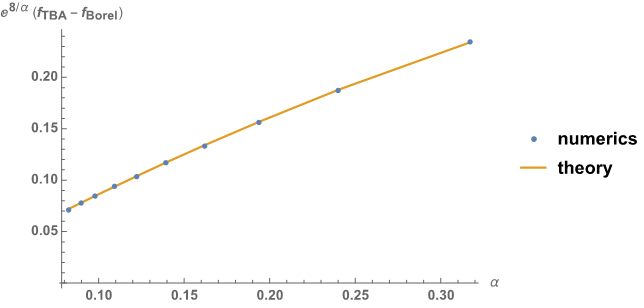
In the previous years we investigated the free energy of the two dimensional O(4) sigma model in a magnetic field. Using the integrability of the model we determined 2,000 perturbative coefficients with very high precision, which enabled us to investigate the analytic structure of the density and energy on the Borel plane [1,2]. Using asymptotic analyses, we identified and characterized the leading singularities and determined the corresponding leading, exponentially small in coupling corrections. We then confronted these results with the high precision numerical solution of the exact integral equation and found complete agreement, see Figure 1. Later we elevated these results to an analytical level in [3].

HK

Figure 1. Comparison of the numerical solution of the exact integral equation and the leading exponentially small non-perturbative corrections determined from the asymptotics of the perturbative series using resurgence theory.

We then investigated with similar methods the ground-state energy of the integrable two dimensional O(3) sigma model in a magnetic field: By determining a large number of perturbative coefficients we explored the closest singularities of the corresponding Borel function. We then confronted its median resummation to the high precision numerical solution of the exact integral equation and observed that the leading exponentially suppressed contribution was not related to the asymptotics of the perturbative coefficients. By analytically expanding the integral equation we calculated the leading non-perturbative contributions up to fourth order and this time we found complete agreement. These anomalous terms could be attributed to instantons, while the asymptotics of the perturbative coefficients seems to be related to renormalons. [4]

Additonal results in other subjects. — We continued the investigation of the boundary state bootstrap and asymptotic overlaps in the AdS/dCFT correspondence and in simple integrable models. We analysed various integrable spin chains and their relation to factorized overlaps with twists, and to cellular automata, spin chains exhibiting Hilbert space fragmentation and solvable real time dynamics. We investigated the finite size corrections of form factors in non-diagonally scattering integrable quantum field theories. We also studied integrable field theories with interacting massless sectors as well as the selfdual point of the sinh-Gordon theory.

2020

General aims. The aim of our research is to develop novel integrable methods in 1+1 dimensional quantum field theories and apply them in particle- and statistical- physical systems, in particular, in the holographic duality, which connects 3+1 dimensional gauge theories to 1+1 dimensional string theory.

Defect version of the holographic duality.  — In the original version of the holographic duality the maximally supersymmetric 3+1 dimensional gauge theory is mapped to the quantum theory of superstrings propagating both on the 4+1 dimensional anti de Sitter space and the 5 dimensional sphere. The scaling dimensions of the gauge theories’ local operators are equivalent to the string energies, which can be calculated as the finite size spectrum in a 1+1 dimensional integrable quantum field theory. In the defect version of the correspondence a defect surface is introduced in the gauge theory, which allows nonvanishing  1-point functions for local operators. These expectation values can be calculated as overlaps between an integrable boundary state and finite volume multiparticle states. This is a very hot research direction in which we advanced considerably. First,  we managed to calculate these expectation values using integrable methods for all scaling operators at the leading order of perturbation theory in the SO(6) sector [1]. We then classified all integrable boundary states and calculated the corresponding overlaps with multiparticle states [2]. These results provide the expectation values valid for any coupling, not just at leading order, but neglects wrapping effects, which can appear at higher loops. Our results are also relevant in other boundary problems, such as in the calculation of vacuum expectation of supersymmetric Wilsop loops, which correspond to gluon scattering amplitudes.

Integrable spin chains — The Heisenberg spin chain is the prototypical example, where new ideas and techniques can be developed. In the last year we developed a new method based on functional relations, which allowed to determine the spectrum of the spin chain. Previous methods based on the Bethe ansatz gave non-physical solutions, which were difficult to identify and eliminate. In our approach every physical solution of the Bethe ansatz corresponds to rational solutions of the functional equations. Borrowing ideas from algebraic geometry we managed to use these functional relations to calculate the partition function for relatively large spin chains, which allowed to  map the phase structure of these models.

Black holes — We investigated non-extremal Kerr black holes from a near horizon perspective within Einstein gravity. By expanding around null hypersurfaces, such as generic Kerr black hole horizons, we studied the associated surface charges, their symmetries and the corresponding phase space. Our surface charges are not integrable in general: their integrable part generates an algebra including superrotations and a BMS3 -type algebra, while the non-integrable part accounts for the flux passing through the null hypersurface. We put our results in the context of earlier constructions of near horizon symmetries, soft hair and of the program to semi-classically identify Kerr black hole microstates.

Finite volume expectation values  — The expectation values of local operators in a finite volume is an interesting problem, which has connections via the holographic duality to the 3-point functions of the maximally supersymmetric gauge. Additionally, they play a crucial role in the formulation of generalized hydrodynamics of integrable models.  Continuing our previous research on finite volume form factors we derived exact formulae for all expectation values of local operators in the sine-Gordon theory. We tested these results in the pure multi-soliton sector by comparing - their ultraviolet limit to Liouville 3-point functions, while - their infrared limit to the previously conjectured LeClair-Mussardo type formula.

The vacuum expectation values of conserved currents played an essential role in the formulation  generalized hydrodynamics.  We used analytic continuation to extend these results for the excited state expectation values in a finite volume. Our formulas are valid for diagonally scattering theories and incorporate all finite size corrections.

New holographic dualities  — In the generalized versions of the holographic duality the  quantum theory of gravity is realized as a hologram taking the form of a quantum field theory at boundary. In our work we searched a gravitational system that allows a nonrelativistic hybrid geometry interpolating the Schrödinger and Lifshitz spacetimes as a solution. As such a candidate an Einstein-Maxwell-Higgs system naturally arose and we verified that this system indeed supports the hybrid geometry with the help of a gauge-fixing term for diffeomorphism. As a result, this gravitational system may be interpreted as a holographic dual of a general nonrelativistic system at the boundary.

2019

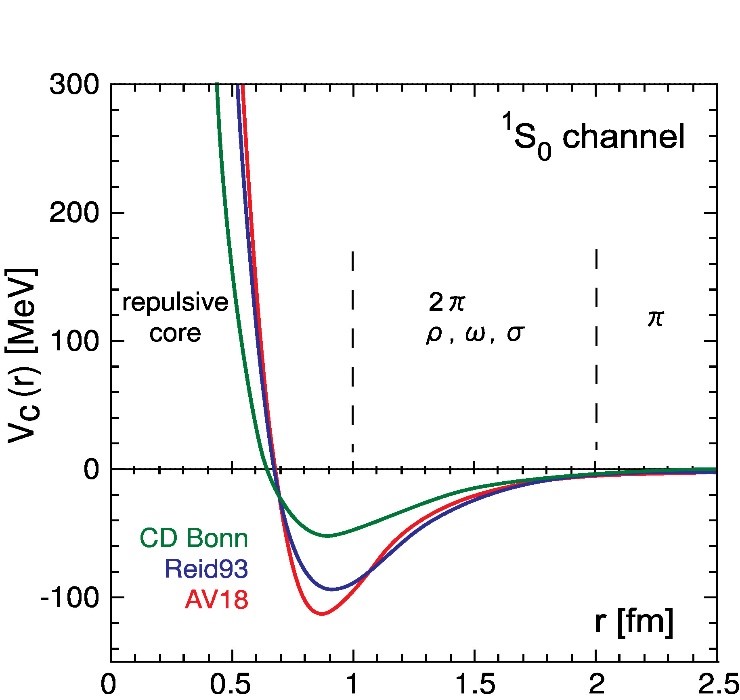
Short distance singularity of the nuclear potential. — The characteristic features of the phenomenological nucleon potentials, shown in Fig. 1, are well known. The force at medium to long range is attractive; this feature is due to pion and other heavier meson exchange. The strong repulsive core of the potential at short distances had no satisfactory theoretical explanation until recent advances in lattice QCD simulations made possible to determine the potential in fully dynamical lattice QCD. The results of this first principles calculation resemble the phenomenological potential, including its repulsive core. The short distance behaviour of the potential was subsequently studied also in perturbative QCD. The results of the perturbative calculations [3] show that at extremely short distances the potential behaves as 1/r2 (up to log corrections characteristic to perturbative QCD). Calculations in holographic QCD also give a similar inverse square potential at short distances.

Although the recent theory of low energy nuclear interactions is based on effective chiral field theory (EFT) of mesons and nucleons, the phenomenological potential remains important as a source of intuition and is still often used in the study of multinucleon systems and in the determination of the equation of state for dense nuclear matter as starting point of quantitative work. As can be seen in Fig. 1, the phenomenological potential is not uniquely determined. Nevertheless, known versions more or less agree on its main qualitative features.

holografikus kvantumtérelmélet 1


Figure 1. The three most popular phenomenological nucleon potentials.


From a purist viewpoint the notion of nuclear potential does not make much sense below 0.5 fermi for various reasons: the nonrelativistic quantum-mechanical description based on the Schrödinger equation cannot work beyond about 350 MeV laboratory energy because it cannot incorporate particle production; relativistic effects become important at the corresponding energy range; finally the composite nature of nucleons becomes relevant at distances comparable to their size. Therefore, a meaningful reconstruction of an effective nuclear potential must be based on experimental data in the 0 < ELAB < 350 MeV energy range. This leads to the problem of quantum inverse scattering with incomplete data.

Inverse scattering with incomplete data [1]. — In the theory of inverse scattering with incomplete data the lack of full information on the scattering phase shifts is (partially) compensated by other, additional pieces of information. In this paper we concentrate on the singular core of the potential and assume it behaves for small r as U(r) =n(n+1)/r2, where the parameter n is non-negative (repulsive core). In a recent paper [2] we studied the singular behaviour of the nucleon potential in the 1S0 channel and in the 3S1-3D1 coupled channels. Assuming a rational, Bargmann type S-matrix, a 1/r2 asymptotic behaviour naturally emerges. In this method the incompleteness of the scattering data is compensated by the assumption on the rational form of the S-matrix. For Bargmann-type S-matrices the strength parameter n can only take integer values.

However, on physical grounds, there is no reason why the effective strength parameter n should be integer. In the paper [1] we undertook a systematic study of the strength parameter n in various np scattering channels assuming the n(n+1)/r2 form but not requiring n integer. We use the Marchenko method of quantum inverse scattering because this efficient method is applicable to all type of potentials (not necessarily of Bargmann-type). In case of Bargmann potentials the Marchenko method has the extra advantage that the results can be obtained purely algebraically [2]; in other cases it requires the solution of a linear integral equation. Quantum inverse scattering, the problem of finding the potential from scattering data, is completely solved in a mathematically precise way. The potential can be uniquely reconstructed, if full information on scattering at all energies and some additional data related to bound states (binding energies and asymptotic decay constants) are all available. Since this is rarely the case, we worked out a method to extrapolate limited range data.This is possible because the asymptotic large energy behaviour is intimately related to the singularity strength via the generalized Levinson's theorem.

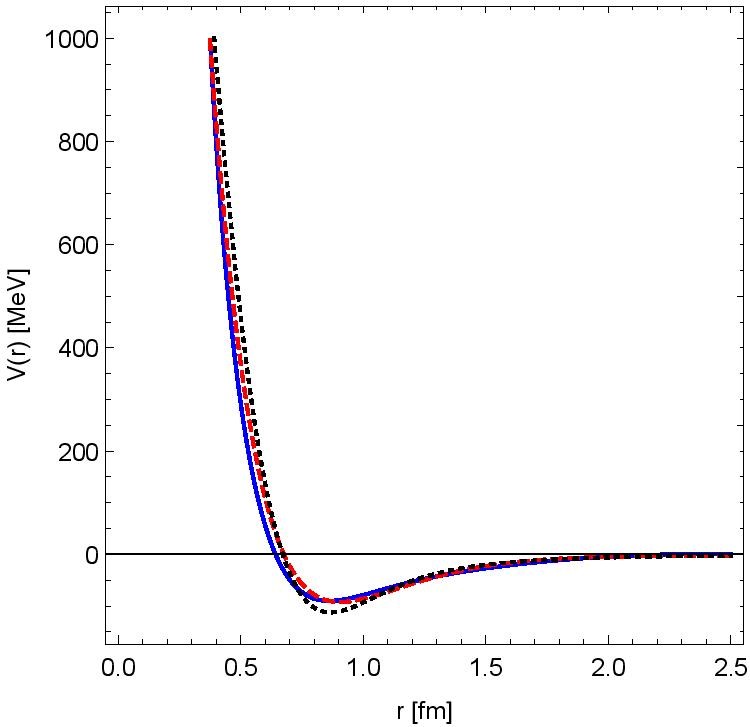
We undertook a systematic study of the n parameter for various low angular momentum partial waves of np scattering: in the 1S0, 3P1, 3P0 and 3D2 channels. We constructed the potential in each channel with a 1/r2 type singular behaviour based on experimental data below 350 MeV LAB energy and extrapolated with some n.  We determined the best choice for n. We found that the singularity of the central potential in the 1S0 channel (see Fig. 2) is best approximated by n= 2:0, an integer. But the best choice for the 3P1, 3P0, 3D2 channels turn out to be n = 2:3, n = 3:2, n= 2:3, respectively.

holografikus kvantumtérelmélet 2

Figure 2. Reconstruction of the 1S0 channel central potential. The solid (blue) line is the potential obtained with our extrapolation method, the dashed (red) line is the Reid93 potential, and the AV18 potential is dotted (black).


2018

Field theoretical derivation of Lüscher's formula and calculation of finite volume form factors 

Quantum Field Theories play an important role in many branches of physics. On the one hand, they provide the language in which we formulate the fundamental interactions of Nature including the electro-weak and strong interactions. On the other hand, they are frequently used in effective models appearing in particle, solid state or statistical physics. In most of these applications the physical system has a finite size: scattering experiments are performed in a finite accelerator/detector, solid state systems are analyzed in laboratories, even the lattice simulations of gauge theories are performed on finite lattices etc. The understanding of finite size effects is therefore unavoidable and the ultimate goal is to solve QFTs for any finite volume. Fortunately, finite size corrections can be formulated purely in terms of the infinite volume characteristics of the theory, such as the masses and scattering matrices of the constituent particles and the form factors of local operators.

For a system in a box of finite sizes the leading volume corrections are polynomial in the inverse of these sizes and are related to the quantization of the momenta of the particles. In massive theories the subleading corrections are exponentially suppressed and are due to virtual processes in which virtual particles ``travel around the world'. 

 
The typical observables of an infinite volume QFT (with massive excitations) are the mass spectrum, the scattering matrix, the matrix elements of local operators, i.e. the form factors, and the correlation functions of these operators. The mass spectrum and the scattering matrix is the simplest information, which characterize the QFT on the mass-shell. The form factors are half on-shell half off-shell data, while the correlation functions are completely off-shell information. These can be seen from the Lehmann-Symanzik-Zimmermann (LSZ) reduction formula, which connects the scattering matrix and form factors to correlation functions: The scattering matrix is the amputated momentum space correlation function on the mass-shell, while for form factors only the momenta, which correspond to the asymptotic states are put on shell. Clearly, correlation functions are the most general objects as form factors and scattering matrices can be obtained from them by restriction. Alternatively, however, the knowledge of the spectrum and form factors provides a systematic expansion of the correlation functions as well.

The field of two dimensional integrable models is an adequate testing ground for finite size effects. These theories are not only relevant as toy models, but, in many cases, describe highly anisotropic solid state systems and via the AdS/CFT correspondence, solve four dimensional gauge theories. Additionally, they can be solved exactly and the structure of the solution provides valuable insight for higher dimensional theories.

The finite size energy spectrum has been systematically calculated in integrable theories. The leading finite size correction is polynomial in the inverse of the volume and originates from momentum quantization. The finite volume wave-function of a particle has to be periodic, thus when moving the particle around the volume, L,  it has to pick up the ipL translational phase. If the theory were free this phase should be 2pn, in an interacting theory, however, the particle scatters on all the other particles suffering phase shifts, -ilog(S), which adds to the translational phase and corrects the free quantization condition. These equations are called the Bethe-Yang (BY) equations. The energy of a multiparticle state is simply the sum of infinite volume energies but with the quantized momenta depending on the infinite volume scattering matrix. 

The exponentially small corrections are related to virtual processes. In the leading process a virtual particle anti-particle pair appears from the vacuum, one of them travels around the world, scatters on the physical particles and annihilates with its pair. Similar process modifies the large volume momentum quantization of the particles.  The total energy contains not only the particles' energies, but also the contribution of the sea of virtual particles. The next exponential correction contains two virtual particle pairs and a single pair which wrap twice around the cylinder. For an exact description all of these virtual processes have to be summed up, which is provided by the Thermodynamic Bethe Ansatz (TBA) equations. TBA equations can be derived (only for the ground state) by evaluating the Euclidean torus partition function in the limit, when one of the sizes goes to infinity. If this size is interpreted as Euclidean time, then only the lowest energy state, namely the finite volume ground state contributes. If, however, it is interpreted as a very large volume, then the partition function is dominated by the contribution of finite density states. Since the volume eventually goes to infinity the BY equations are almost exact and can be used to derive (nonlinear) TBA integral equations to determine the density of the particles, which minimize the partition function in the saddle point approximation. By careful analytical continuations this exact TBA integral equation can be extended for excited states.

The similar program to determine the finite volume matrix elements of local operators, i.e. form factors, is still in its infancy. Since there is a sharp difference between diagonal and non-diagonal form factors they have to be analyzed separately. For nondiagonal form factors the polynomial finite size corrections, besides the already explained momentum quantization, involve also the renormalization of states, to conform with the finite volume Kronecker delta normalization. The polynomial corrections for diagonal form factors are much more complicated, as they contain disconnected terms and recently we managed to prove they exact form conjectured earlier.  For exponential corrections the situation is the opposite. Exact expressions for the finite volume one-point function can be obtained in terms of the TBA minimizing particle density and the infinite volume form factors by evaluating the one-point function on an Euclidean torus where one of the sizes is sent to infinity. The analytical continuation trick used for the spectrum can be generalized and leads to exact expressions for all finite volume diagonal form factors. For non-diagonal form factors, however, not even the leading exponential correction is known. The aim of our research was to initiate research into this direction.

We developed a novel framework, which provided direct access both to excited states' energy levels and finite volume form factors. The idea was to calculate the Euclidean torus two-point function in the limit, when one of the sizes was sent to infinity. The exact finite volume two-point function then could be used, similarly to the LSZ formula, to extract the information needed: the momentum space two-point function, when continued analytically to imaginary values, had poles exactly at the finite volume energy levels whose residues were the products of finite volume form factors. Of course, the exact determination of the finite-volume two-point function was hopeless in interacting theories, but developing any systematic expansion lead to a systematic expansion of both the energy levels and the form factors. We analyzed two such expansions in our work: in the first, we expanded the two-point function in the volume, which lead to the leading exponential corrections. We performed the calculation for a moving one-particle state. In the second expansion, we calculated the same quantities perturbatively in the coupling in the sinh-Gordon theory. By comparing the two approaches in the overlapping domain we found complete agreement. 

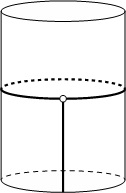
As our final result we could manage to extract the leading exponential volume correction both to the energy level and to the simplest non-diagonal form factor. We compared this energy correction to the expansion of the TBA equation and found complete agreement. The correction contains both the effect of the modification of the Bethe-Yang equation by virtual particles and also these particles' direct contribution to the energy. In the case of the simplest non-diagonal form factor a local operator is sandwiched between the vacuum and a moving one-particle state. Our result for the Lüscher correction is valid for any local operator and has two types of contributions.  The first comes from the normalization of the state. Since virtual particles change the Bethe-Yang equations, they also change the finite volume norm of the moving one-particle state.  The other correction can be interpreted as the contribution of a virtual particle traveling around the world as displayed on Figure 1.

bz1

Figure 1. Graphical interpretation of the Lüscher correction is shown. Solid thick line represents the physical particle which arrives from the infinite past and is absorbed by the operator represented by a solid circle. The trajectory of a virtual (mirror) particle is represented by a half solid, half dashed ellipse. The operator emits this virtual particle, which travels around the world and is absorbed by the operator again leading to a 3-particle form factor.

Since the appearing 3-particle form factor is infinite, we had to regularize it by subtracting the kinematical singularity contribution. Additionally, however, to this infinite subtraction our calculation revealed an extra finite piece, which was related to the derivative of the scattering matrix. We tested all of our results against second order Lagrangian and Hamiltonian perturbation theory in the sinh-Gordon  theory and we obtained perfect agreement. In the future we would like to extend these results for generic non-diagonal finite volume form factor.

2017

Correlation functions of the maximally symmetric 4D quantum gauge theory and finite volume form factors. — The AdS/CFT correspondence relates string theories on anti de Sitter (AdS) backgrounds to conformal gauge theories on the boundary of these spaces. The energies of string states correspond to the scaling dimensions of local gauge invariant operators which determine the space time dependence of the conformal 2- and 3-point functions completely. In order to build all higher point correlation functions of the CFT one needs to determine the 3-point couplings, which is in the focus of recent research.

String theories on many AdS backgrounds are integrable and this miraculous infinite symmetry is the one which enables us to solve the quantum string theory dual to the strongly coupled gauge theory. In the prototypical example the type IIB superstring theory on the AdS5ˣS5 background is dual to the maximally supersymmetric 4D gauge theory.  Integrability shows up in the planar limit and interpolates between the weak and strong coupling sides. The spectrum of string theory, i.e. the scaling dimensions of  local gauge-invariant operators are mapped to the finite volume spectrum of the integrable theory, which has been determined by adapting finite size techniques such as thermodynamic Bethe Ansatz (TBA).

Further important observables such as 3-point correlation functions or nonplanar corrections to the dilatation operator are related to string interactions. A generic approach to the string field theory (SFT) vertex was introduced in our previous work which can be understood as a sort of finite volume form factor of non-local operator insertions in the integrable worldsheet theory. There is actually one case when the 3-point function corresponds to a form factor of a local operator insertion. In the case of heavy-heavy-light operators the string worldsheet degenerates into a cylinder and the SFT vertex is nothing but a diagonal finite volume form factor, as we pointed out in our previous publications.

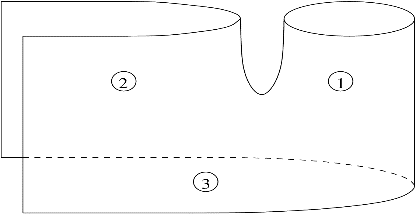
The string field theory vertex describes a process in which a big string splits into two smaller ones. In light-cone gauge fixed string sigma models on AdS5ˣS5 and some similar backgrounds, the string worldsheet theory is integrable and the conserved S5 charge serves as the volume, so that the size of the incoming string exactly equals the sum of the sizes of the two outgoing strings.

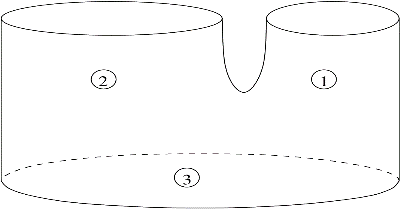
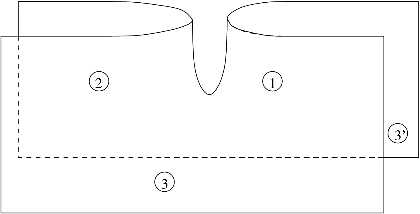
Initial and final states are characterized as multiparticle states of the worldsheet theory on the respective cylinders and we are interested in the asymptotic time evolution amplitudes, which can be essentially described as finite volume form factors of a non-local operator insertion representing the emission of the third string. In order to be able to obtain functional equations for these quantities we suggested to analyze the decompactification limit, in which the incoming and one outgoing volume are sent to infinity, such that their difference is kept fixed. We called this quantity the decompactified string field theory (DSFT) vertex or decompactified Neumann coefficient. We formulated axioms for such form factors, which depend explicitly on the size of the small string, and determined the relevant solutions in the free boson (plane-wave limit) theory. Taking a natural Ansatz for the two particle form factors we separated the kinematical and the dynamical part of the amplitude and determined the kinematical Neumann coefficient in the AdS/CFT case, too. These solutions automatically contain all wrapping corrections in the remaining finite size string, which makes it very difficult to calculate them explicitly in the interacting case, especially for more than two particles. It is then natural to send the remaining volume to infinity and calculate the so obtained octagon amplitudes. One can go even further and introduce another cut between the front and back sheets leading to two hexagons, which were introduced previously and has been explicitly calculated. Since we are eventually interested in the string field theory vertex, we have to understand how to glue back the cut pieces. Our recent paper was an attempt going into this direction. Clearly, gluing two hexagons together we should recover the octagon amplitude. Gluing two edges of the octagon we get the DSFT vertex, while gluing the remaining two edges we would obtain the finite volume SFT vertex, which would be the ultimate goal for the interacting theory.  For the details see Fig. 1.

h1

h2

h3


Figure 1. The string field theory vertex describes the amplitude of the process in which a big string splits into two smaller ones. Initial and final states are characterized as finite volume multiparticle states and the asymptotic time evolution amplitudes can be understood as finite volume form factors of a non-local operator insertion (left figure). In calculating these quantities we go to the decompactification limit, in which two of the volumes are sent to infinity, leading to infinite volume form factors (middle figure). By sending the remaining volume to infinity we obtain the octagon amplitudes (right figure).

The study of various observables in integrable quantum field theories in finite volume in a natural way can be decomposed into a number of stages. Firstly, the problem posed in infinite volume typically yields a set of axioms or functional equations for the observable in question which often can be solved explicitly. The key property of the infinite volume formulation is the existence of analyticity and crossing relations which allow typically for formulating functional equations.  Secondly one considers the same problem in a large finite volume neglecting exponential corrections of order e-mL. In this case the answers are mostly known like for the energy levels, generic form factors and diagonal form factors.  However, some of these answers were still conjectural until we proved them in the last year.  Thirdly, one should incorporate the exponential corrections of order e-mL, which are often termed as wrapping corrections as they have the physical interpretation of a virtual particle wrapping around a noncontractible cycle. The key example here are the Lüscher corrections for the mass of a single particle and their multiparticle generalization what we obtained a few years ago. Once one wants to incorporate multiple wrapping corrections, the situation becomes much more complicated however in some cases this can be done.

In the case of the spectrum of the theory on a cylinder, fortunately one does not need to go through the latter computations as there exists a thermodynamic Bethe Ansatz formulation which at once resums automatically all multiple wrapping corrections and provides an exact finite volume answer. Unfortunately for other observables like the string interaction vertex we do not have this technique at our disposal and we hoped that understanding the structure of multiple wrapping corrections shed some light on an ultimate TBA like formulation. This was another motivation for our work and in fact one of our new results is an integral representation for the exact pp-wave Neumann coefficient which involves a measure factor reminiscent of various TBA formulas.

We argued in our paper that the quantitative structure of the gluing procedure may be efficiently understood within the so-called cluster expansion (equivalently compactification in the mirror channel). There the main ingredient was the asymptotic large mirror volume expectation value for the observable in question which decomposed into a linear combination of measure factors and appropriate infinite volume quantities. This is a standard way to understand ground state energy and the LeClair-Mussardo formula for one point expectation values in relativistic integrable theories. In our paper we adopted this framework to the case of the octagon and the decompactified SFT vertex. We demonstrated that one can resum the multiple wrapping corrections for the octagon into the exact decompactified SFT vertex. This necessitates a nontrivial, but quite natural modification of the multiple wrapping measure. We then proceed to interpret this modification through the cluster expansion where it turns out to arise from certain diagonal terms. We then show that similarly one can resum the decompactified SFT vertex and recover the exact finite volume pp-wave Neumann coefficients.

Elméleti Fizika Osztály

Részecskefizikai és Térelméleti Kutatócsoport
Nehézion-fizikai Kutatócsoport
Holografikus Kvantumtérelmélet "Lendület" Kutatócsoport
Gravitációfizikai Kutatócsoport
Femtoszkópia Kutatócsoport
Munkatársak

További linkek

  • Közérdekű adatok
  • Telefonkönyv
  • Állások
  • Látogatás
  • Impresszum
  • Esélyegyenlőség
  • MI nagykövetek
  • Visszaélés bejelentése

User Logined

  • Bejelentkezés

Infrastruktúra

  • Adatközpont
  • Számítógép Hálózati Központ
  • Könyvtár
  • Telephelyi weboldal
  • További infrastruktúrák

Cím

1121 Budapest
Konkoly-Thege Miklós út 29-33.


Kapcsolat

Központi telefon: +36-1-392-2222
Főigazgatói titkárság: +36-1-392- 2512
Sajtókapcsolat: +36-30-487-9869
E-mail: wigner@wigner.hun-ren.hu
facebook logo Kövess minket a Facebookon!
 
youtube logo Youtube csatornánk elérhetősége


Footer

  • Kapcsolat
Széchenyi 2020