

2021
From perturbative to non-perturbative — Perturbation theory proved to be a useful tool in calculating physical processes for the electromagnetic and weak interactions, but it has had only a limited success for their strong counterpart. Indeed, phenomena such as confinement and dynamical mass generation are inherently non-perturbative and cannot be accessed from the few known perturbative coefficients. Moreover, perturbation theory in QCD is expected to be asymptotic, which should manifest itself in the factorial growth of the coefficients. This factorial growth can be traced back to the proliferation of Feynmann diagrams as well as to integrations for various IR and UV domains of the loop momenta in specific renormalon diagrams. They signal exponentially suppressed non-perturbative contributions, which usually originate from non-trivial saddle points in the path integral. The relation between the perturbative expansion and the non-perturbative effects can be established in the resurgence theory. It would be ideal to apply this theory to non-perturbative phenomena in QCD, unfortunately however, we do not have enough perturbative coefficients. Thus, we decided to analyse toy models, which share important features with QCD, but nevertheless are tractable. The two-dimensional O(N) symmetric sigma models are exactly of this type as they exhibit a dynamically generated mass gap and are asymptotically free in perturbation theory. On the same time, they are integrable and the relevant physical quantities such as the mass gap, scattering matrices, and ground state energy can be calculated exactly. Our aim was to use these sigma models to reveal the relation between the perturbative and non-perturbative effects and to establish the first steps in the full resurgence program, which lives its renaissance nowadays.
In resurgence theory one can simply cure the factorial growth of the perturbative coefficients by switching to the Borel transform, which is obtained by dividing out this factorial growth in the perturbative series (ensuring constant asymptotics) and to sum up the corresponding series. The so modified function (on the Borel plane) has a finite radius of convergence and exhibits pole and cut singularities. The analytical continuation of the Borel transform reveals the location of these poles and cuts, which are typically on the real line. The inverse Borel transformation involves an integration of the analytically continued function on the positive real line. In case of singularities there we have to shift the contour a bit above or below the positive real line leading to an ambiguity in the result. This ambiguity is purely imaginary and exponentially small in the coupling. Poles correspond to single exponentials, but each cut to an exponential multiplied with a power series, which by itself is also asymptotic. The cancellation of the ambiguities requires the incorporation of the contributions of non-trivial non-perturbative saddle points. These are exponentials with a possible power series in the coupling and the full physical expression contains these double sums, which can be written as a transseries. Resurgence theory connects the power series multiplying the various exponentials to each other.
In the previous years we investigated the free energy of the two dimensional O(4) sigma model in a magnetic field. Using the integrability of the model we determined 2,000 perturbative coefficients with very high precision, which enabled us to investigate the analytic structure of the density and energy on the Borel plane [1,2]. Using asymptotic analyses, we identified and characterized the leading singularities and determined the corresponding leading, exponentially small in coupling corrections. We then confronted these results with the high precision numerical solution of the exact integral equation and found complete agreement, see Figure 1. Later we elevated these results to an analytical level in [3].
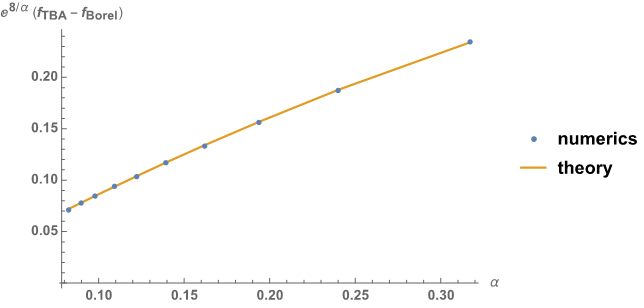
Figure 1. Comparison of the numerical solution of the exact integral equation and the leading exponentially small non-perturbative corrections determined from the asymptotics of the perturbative series using resurgence theory.
We then investigated with similar methods the ground-state energy of the integrable two dimensional O(3) sigma model in a magnetic field: By determining a large number of perturbative coefficients we explored the closest singularities of the corresponding Borel function. We then confronted its median resummation to the high precision numerical solution of the exact integral equation and observed that the leading exponentially suppressed contribution was not related to the asymptotics of the perturbative coefficients. By analytically expanding the integral equation we calculated the leading non-perturbative contributions up to fourth order and this time we found complete agreement. These anomalous terms could be attributed to instantons, while the asymptotics of the perturbative coefficients seems to be related to renormalons. [4]
Additonal results in other subjects. — We continued the investigation of the boundary state bootstrap and asymptotic overlaps in the AdS/dCFT correspondence and in simple integrable models. We analysed various integrable spin chains and their relation to factorized overlaps with twists, and to cellular automata, spin chains exhibiting Hilbert space fragmentation and solvable real time dynamics. We investigated the finite size corrections of form factors in non-diagonally scattering integrable quantum field theories. We also studied integrable field theories with interacting massless sectors as well as the selfdual point of the sinh-Gordon theory.